

The appeal of a wireless home theater system extends far beyond eliminating visible cables. Today's wireless audio technology has matured to deliver high-fidelity sound that rivals traditional wired configurations, making it possible to create an immersive cinema experience without the complexity of running speaker wire through walls and ceilings. Whether you're designing a dedicated home cinema room or upgrading your existing entertainment space, understanding the capabilities and limitations of wireless systems helps you make informed decisions about your audio setup.
Understanding Wireless Home Theater Technology
Modern wireless home theater systems utilize advanced transmission protocols that preserve audio quality while eliminating physical connections between components. The technology has evolved significantly over the past decade, with manufacturers developing proprietary wireless standards alongside universal protocols.
WiSA (Wireless Speaker and Audio Association) represents one of the most robust wireless audio standards available today. This wireless technology transmits uncompressed, high-definition audio with extremely low latency, typically under 4 milliseconds. This minimal delay ensures perfect synchronization between audio and video, a critical requirement for home theater applications.
Traditional wireless protocols like Bluetooth and Wi-Fi have also improved dramatically. Bluetooth 5.0 and newer versions offer extended range and higher bandwidth, while Wi-Fi-based systems can handle multi-channel audio streams without compression artifacts. The choice between these technologies depends on your specific requirements for audio quality, system expandability, and budget considerations.
Key Components of Wireless Systems
A complete wireless home theater system requires several interconnected elements:
- Wireless transmitter or hub that processes audio signals from your source devices
- Wireless speakers with built-in amplifiers and receivers
- Subwoofer for low-frequency effects, which may be wireless or wired
- Remote control or app interface for system management
- Power connections for each wireless speaker (wireless refers to audio signal, not power)
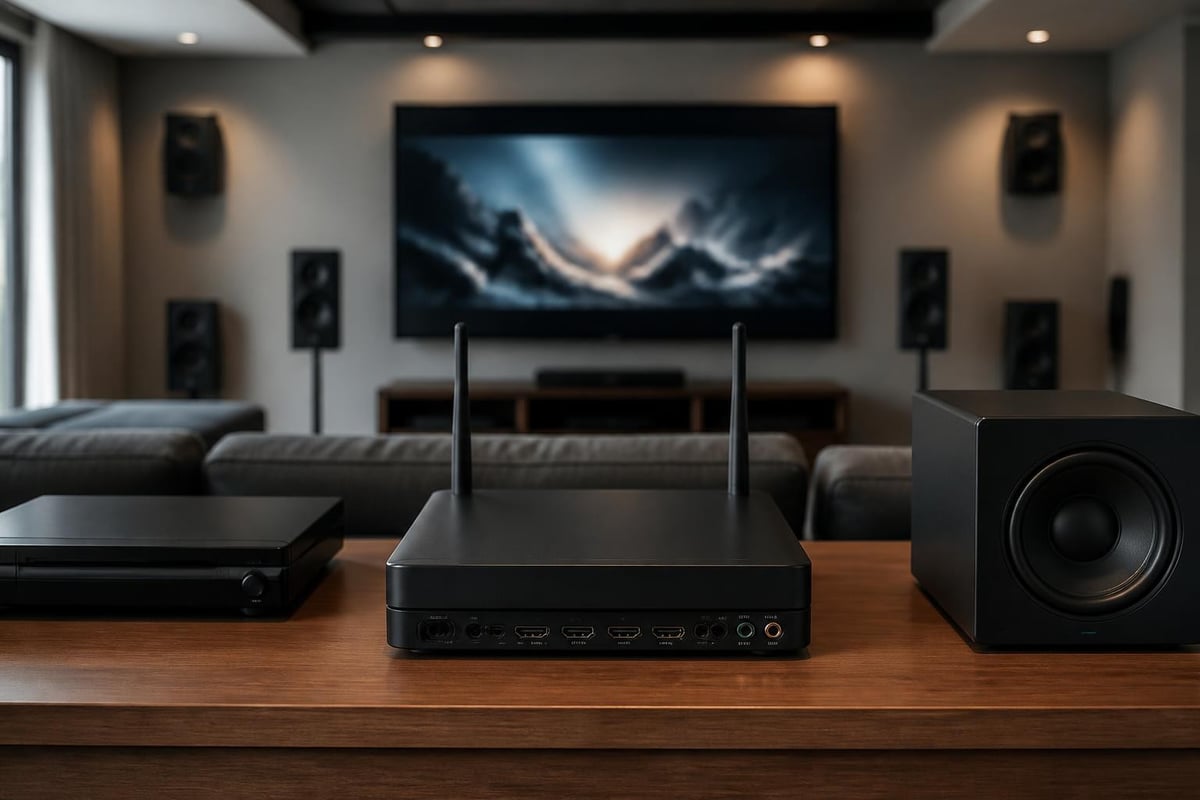
The transmitter serves as the central component, receiving audio from your television, streaming device, or AV receiver and distributing it wirelessly to positioned speakers throughout your room. Modern transmitters support multiple audio formats including Dolby Atmos and DTS:X for object-based surround sound.
Performance Comparison: Wireless vs. Wired
Many home theater enthusiasts question whether wireless systems can truly match the performance of traditional wired configurations. The answer depends on the specific technology and implementation quality you choose.
| Feature | Wired Systems | Wireless Systems |
|---|---|---|
| Audio Quality | Uncompressed, full bandwidth | High-quality with proper protocols (WiSA, proprietary) |
| Installation Complexity | Requires in-wall wiring | Simplified placement, power outlets needed |
| Latency | Zero inherent delay | 1-4ms with quality systems |
| Reliability | No interference concerns | Potential RF interference in rare cases |
| Future Expandability | Limited by existing wiring | Easy to add or relocate speakers |
| Initial Cost | Lower equipment cost, higher installation | Higher equipment cost, lower installation |
Modern wireless home theater systems can rival wired setups when properly implemented, particularly for residential applications where convenience and aesthetics matter significantly. The advancements in wireless transmission have largely eliminated the quality gap that once existed between these approaches.
Real-World Audio Quality
Professional testing reveals that premium wireless home theater systems deliver frequency response and dynamic range comparable to mid-to-high-end wired configurations. The key differentiator lies in the transmission protocol rather than the wireless nature itself.
Systems using uncompressed audio transmission maintain the full detail and spatial information critical for immersive home cinema experiences. Compressed wireless protocols, while acceptable for casual listening, may introduce subtle artifacts that discerning listeners notice during quiet passages or complex musical sequences.
Planning Your Wireless Home Theater Layout
Strategic speaker placement remains essential regardless of whether your system uses wireless technology. The advantage of wireless configurations lies in your flexibility to position speakers optimally without constraint from cable routing.
Optimal Speaker Positioning
For a 5.1 wireless home theater system:
- Center channel directly above or below your display, angled toward the primary seating position
- Front left and right speakers positioned 22-30 degrees off-center from the main viewing position
- Surround speakers placed 90-110 degrees to the sides of the listening area, slightly behind the seating
- Subwoofer in a corner or along a wall for bass reinforcement (location less critical due to low-frequency omnidirectionality)
Dolby Atmos configurations require additional height channels. Wireless systems excel here because ceiling speaker installation becomes dramatically simpler. You can mount upward-firing speakers on your existing floor-standing units or install in-ceiling speakers without running wires through the attic.
The freedom to experiment with speaker placement helps you optimize your acoustic environment. Moving a wireless speaker takes minutes rather than hours, allowing you to fine-tune your soundstage until you achieve the perfect balance.
Installation and Setup Process
Installing a wireless home theater system follows a straightforward process that most homeowners can complete without professional assistance, though expert calibration often yields superior results.
Initial Setup Steps:
- Unbox and position your wireless speakers in their approximate final locations
- Connect the wireless transmitter to your television or AV receiver
- Plug each wireless speaker into nearby power outlets
- Power on the system and initiate the pairing sequence
- Run the automated room calibration program
- Verify proper channel assignment and synchronization
Most modern wireless systems include automated calibration routines that use a measurement microphone to analyze your room acoustics. These programs adjust speaker levels, timing, and equalization to compensate for room characteristics and speaker placement variations.
Advanced Configuration Options
After completing basic setup, explore advanced settings to refine your wireless home theater system performance:
| Setting Category | Adjustments Available | Impact on Performance |
|---|---|---|
| Speaker Levels | Individual channel volume trim | Balances output across all speakers |
| Distance/Delay | Time alignment correction | Ensures coherent soundstage |
| Crossover Frequency | Bass management settings | Optimizes subwoofer integration |
| Dynamic Range | Compression for late-night viewing | Reduces loud peaks while preserving dialogue |
| Wireless Channel | RF frequency selection | Minimizes interference from other devices |
Professional installers often use measurement equipment beyond the included calibration microphone to achieve reference-level performance. If you're investing in a premium wireless system for a dedicated home cinema room, professional calibration ensures you extract maximum value from your equipment.
For homeowners pursuing exceptional audio quality, working with specialists who understand both the technical aspects of wireless transmission and the art of acoustic optimization makes a substantial difference. Custom installations by experienced professionals ensure your wireless home theater system delivers performance that matches or exceeds commercial cinema standards.
Popular Wireless Home Theater Configurations
Different room sizes and usage patterns call for varying wireless system configurations. Understanding the options helps you select the appropriate setup for your space and preferences.
5.1 Wireless Systems
The traditional 5.1 configuration (five speakers plus subwoofer) remains the most popular choice for home theater applications. This setup provides convincing surround sound for most content while maintaining reasonable cost and complexity.
Quality 5.1 wireless systems deliver exceptional performance for movies, television, and gaming. The discrete surround channels create enveloping ambient effects, while the center channel anchors dialogue to the screen image. Modern implementations often support virtualization technologies that create height perception from the floor-level speakers.
7.1 and Atmos Configurations
Enthusiasts seeking ultimate immersion often upgrade to 7.1 systems or Dolby Atmos configurations with height channels. Wireless technology particularly benefits these advanced setups because they require additional speaker placements that would be challenging with wired connections.
Sony’s wireless Dolby Atmos systems demonstrate how manufacturers are pushing wireless capabilities into premium performance categories. These systems deliver overhead sound effects that enhance realism for compatible content, from aircraft flyovers to rainfall.
Benefits of wireless Atmos systems:
- Simplified installation of ceiling or height-effect speakers
- Flexibility to add or remove height channels based on room acoustics
- Reduced visual impact compared to wired ceiling installations
- Easy relocation if you redesign your space
Addressing Common Wireless Concerns
Despite technological advances, some home theater enthusiasts remain skeptical about wireless audio performance. Understanding the facts helps dispel misconceptions and set appropriate expectations.
Latency and Synchronization
Audio-video synchronization represents the most critical concern for home theater applications. Even small delays between picture and sound become noticeable and distracting, particularly during dialogue scenes.
Premium wireless home theater systems using WiSA or proprietary protocols maintain latency under 4 milliseconds, well below the threshold of human perception. For context, the speed of sound creates approximately 1 millisecond of delay per foot of distance, so wireless latency in quality systems remains imperceptible.
Budget wireless systems using standard Bluetooth may exhibit 100-200 milliseconds of latency, making them unsuitable for video content. Always verify the latency specifications before purchasing any wireless home theater system.
Reliability and Interference
Modern wireless home theater systems operate on less congested radio frequencies than Wi-Fi networks and household devices. Quality systems include automatic channel selection that identifies clear frequencies and adapts when interference occurs.
Interference issues primarily affect lower-quality systems or installations in dense apartment buildings with numerous competing wireless signals. Proper installation in typical residential environments rarely encounters reliability problems with current-generation equipment.
Integration with Smart Home Systems
Contemporary wireless home theater systems increasingly incorporate smart home integration capabilities that extend beyond basic audio reproduction. These features enhance convenience and create unified control experiences.
Smart integration features:
- Voice control through Amazon Alexa, Google Assistant, or Apple Siri
- Automated power management based on television status
- Scene programming that adjusts audio settings for different content types
- Multi-room audio distribution to extend music throughout your home
- Streaming service integration with direct access to Spotify, Tidal, and others
Multi-room wireless speakers have become sophisticated enough to serve dual purposes as both dedicated home theater channels and distributed audio zones. This flexibility allows your investment in wireless speakers to serve multiple functions beyond cinema viewing.
The convergence of home theater and whole-home audio creates opportunities for integrated systems that adapt to different usage scenarios. Your wireless home theater system can seamlessly transition from providing immersive movie sound to distributing music throughout your living spaces.
Maintenance and Troubleshooting
Wireless home theater systems require minimal ongoing maintenance, though occasional optimization ensures consistent performance over time.
Routine Maintenance Tasks
- Update firmware on transmitters and speakers when manufacturers release improvements
- Verify wireless connections remain strong and stable
- Clean speaker grilles to prevent dust accumulation affecting sound quality
- Re-run calibration after furniture changes or speaker repositioning
- Check power connections to ensure speakers receive consistent electricity
Firmware updates often include performance enhancements, bug fixes, and support for new audio formats. Manufacturers typically release updates several times annually for current-generation products.
Common Issues and Solutions
| Problem | Likely Cause | Solution |
|---|---|---|
| Speaker dropout | Interference or distance | Reposition transmitter, change wireless channel |
| Audio sync delay | Incorrect settings | Enable low-latency mode, update firmware |
| Unbalanced sound | Calibration needed | Re-run room correction program |
| No sound from specific speaker | Connection lost | Re-pair speaker to transmitter |
| Distortion at high volume | Overdriving speakers | Reduce master volume, adjust individual levels |
Most troubleshooting involves simple resets or configuration adjustments rather than hardware repairs. Wireless systems' modular nature means individual component replacement is straightforward if failures occur.
Future Developments in Wireless Audio
The wireless home theater system market continues evolving with emerging technologies promising further improvements in performance and convenience.
Manufacturers are developing higher-bandwidth wireless protocols that support lossless audio formats at higher sample rates. These advances will satisfy audiophiles who currently prefer wired connections for ultimate fidelity.
Battery-powered wireless speakers represent another frontier, though current lithium battery technology cannot provide sufficient power for extended home theater use at reference volume levels. Innovations in wireless power transmission may eventually eliminate even the power cord requirement.
Artificial intelligence and machine learning increasingly enhance automated room calibration and sound optimization. Future wireless systems will adapt continuously to changing room conditions and content characteristics, maintaining ideal performance without manual intervention.
Selecting the Right Wireless System
Choosing an appropriate wireless home theater system requires balancing performance requirements, budget constraints, and aesthetic preferences. The following considerations guide your decision:
Essential evaluation criteria:
- Audio transmission protocol (WiSA, proprietary, or standard wireless)
- Number of channels supported (5.1, 7.1, Atmos configurations)
- Compatible audio formats (Dolby Digital Plus, Atmos, DTS:X)
- Expandability options for future upgrades
- Integration capabilities with existing equipment
- Brand reputation and support for firmware updates and assistance
Premium systems justify their cost through superior components, lower latency, and more robust wireless transmission. Entry-level options provide acceptable performance for casual viewing but may disappoint enthusiasts seeking reference-quality sound.
THX and WiSA certified systems undergo rigorous testing to verify performance standards, providing confidence that you're purchasing equipment capable of delivering exceptional results. These certifications particularly matter for dedicated home cinema installations where audio quality directly impacts the viewing experience.
Modern wireless home theater systems have matured into viable alternatives to traditional wired configurations, offering compelling combinations of performance, convenience, and aesthetic appeal. The technology continues advancing rapidly, with current systems delivering audio quality that satisfies all but the most demanding audiophiles while eliminating installation complexity. Whether you're building a dedicated cinema room or enhancing your living room entertainment, ANR media brings decades of expertise in custom home cinema and audio-video solutions, from wireless multiroom configurations to bespoke cinema room conversions that deliver professional-grade performance tailored to your space and preferences.