

Building an exceptional home cinema experience requires understanding the fundamental home theater components that work together to deliver immersive sound and stunning visuals. Whether you're planning a dedicated cinema room or upgrading an existing setup, knowing which components matter most and how they interact will help you make informed decisions that align with your budget and performance goals. This guide breaks down the essential elements of a modern home theater system, from audio foundations to display technologies and the connectivity that ties everything together.
Understanding Core Audio Components
The audio system forms the heart of any home theater, and selecting the right home theater components for sound reproduction determines whether you experience true cinematic immersion or simply loud noise. Modern audio setups range from simple soundbars to complex multi-channel speaker arrays.
AV Receivers: The System Hub
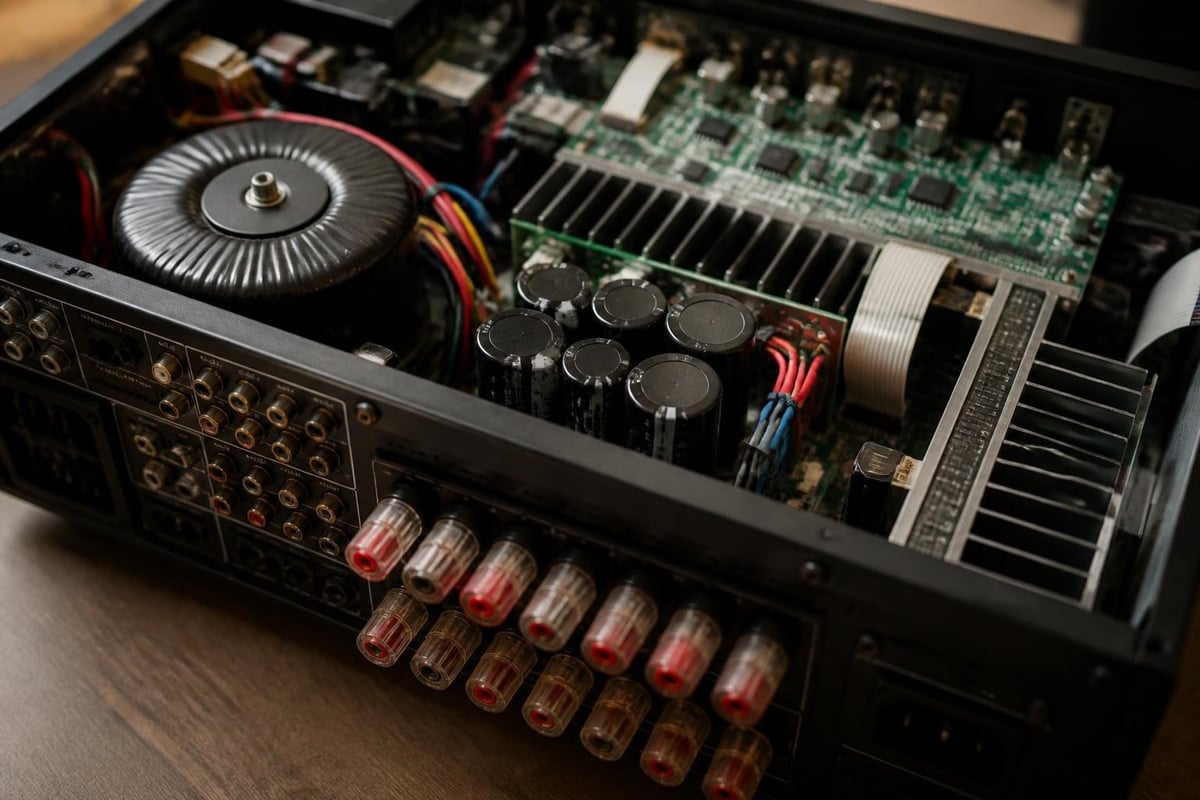
An audio-video receiver serves as the command center for your entire home theater. This single component processes all audio and video signals, decodes surround sound formats, amplifies speaker outputs, and routes content to your display.
Key receiver features to consider:
- Power output: Measured in watts per channel, typically ranging from 50W to 150W for home use
- Channel configuration: 5.1, 7.1, 9.2, or more channels for Dolby Atmos and immersive formats
- HDMI connectivity: Number of inputs/outputs and support for 4K, 8K, HDR10, Dolby Vision
- Room correction: Automated calibration systems like Audyssey, Dirac Live, or YPAO
- Streaming capabilities: Built-in WiFi, AirPlay 2, Chromecast, or HEOS for wireless audio
Premium receivers in 2026 universally support object-based audio formats and feature advanced processing for height channels. When selecting a receiver, ensure it has enough HDMI inputs for all your source devices plus one or two spare ports for future expansion.
Speaker Systems and Configurations
Speakers transform electrical signals into the sound waves that create your listening experience. The quality, placement, and configuration of your speakers matter more than almost any other home theater components.
A traditional 5.1 system includes five main speakers plus one subwoofer. Modern configurations extend to 7.1.4 or even 9.2.6 setups, where the third number represents overhead or height speakers for immersive audio.
| Configuration | Speakers Included | Best For |
|---|---|---|
| 3.1 | L, C, R + subwoofer | Small rooms, budget builds |
| 5.1 | Front L/R, center, surround L/R + sub | Standard home theaters |
| 7.1.4 | 7 ear-level + 4 height + sub(s) | Dedicated cinema rooms with Atmos |
| 9.2.6 | 9 ear-level + 6 height + 2 subs | Premium installations |
Speaker placement fundamentals:
- Center channel: Directly above or below the display, angled toward listening position
- Front left/right: 22-30 degrees from center viewing position, forming an arc
- Surrounds: 90-110 degrees from center, slightly above ear level
- Height speakers: Ceiling-mounted or upward-firing modules for overhead effects
- Subwoofers: Corner placement or multiple subs for even bass distribution
The Dolby Atmos installation guidelines provide detailed speaker positioning recommendations that ensure optimal performance from immersive audio formats.
Subwoofers and Bass Management
Low-frequency effects require dedicated subwoofers because standard speakers cannot reproduce the deep bass essential for cinematic impact. Subwoofers handle frequencies below 80Hz, delivering the rumble of explosions, the weight of musical scores, and the physical presence that defines premium home theater.
Dual subwoofer configurations have become standard in quality installations. Two properly positioned subs eliminate bass nulls and peaks caused by room modes, creating more consistent low-frequency response throughout the seating area.
Display Technologies and Selection
Your display serves as the visual centerpiece, and choosing between projection and flat-panel technologies depends on room characteristics, ambient light control, and desired screen size.
Projectors Versus Large-Format Displays
Projectors remain the gold standard for dedicated home cinema rooms where you can control lighting and achieve screen sizes exceeding 100 inches. Modern 4K laser projectors offer 2,000+ lumens brightness, HDR support, and 20,000-hour light source lifespans without lamp replacements.
Projector advantages:
- True cinematic scale with screens from 100 to 150+ inches
- Better value per inch of screen size
- Reduced eye strain from reflected rather than emitted light
- Authentic theater aesthetic for dedicated rooms
Large OLED and Mini-LED displays compete effectively in multi-purpose spaces. An 85-inch OLED delivers perfect blacks, instant response times, and exceptional HDR performance while functioning in rooms with ambient light.
Consider your room's light control capabilities. Projectors demand darkness for optimal contrast, while premium flat panels perform well even with windows and moderate lighting.
HDR Formats and Color Performance
High Dynamic Range represents one of the most significant advances in display technology. HDR10, Dolby Vision, and HDR10+ expand the brightness range from pure black to peak highlights exceeding 1,000 nits.
Your display and source devices must support matching HDR formats. Most content uses HDR10 as a baseline, while Dolby Vision adds dynamic metadata that optimizes each scene individually. Premium home theater components support all major HDR formats to ensure compatibility.
Source Components and Content Delivery
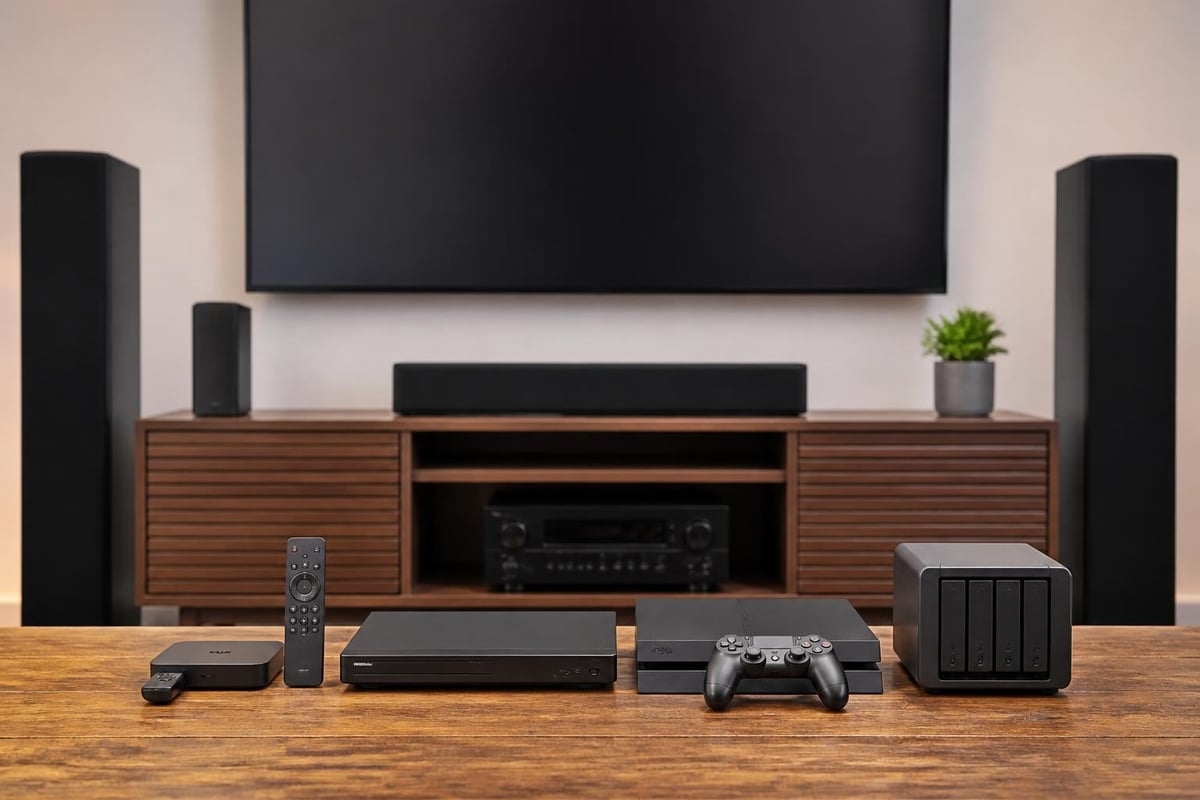
The devices that deliver content to your system determine available quality levels and format support. Source selection among your home theater components directly impacts what you can watch and how good it looks.
Ultra HD Blu-ray Players
Physical media still offers the highest quality home video with bitrates reaching 128 Mbps, far exceeding streaming services. Ultra HD Blu-ray discs deliver true 4K resolution with lossless Dolby Atmos or DTS:X audio tracks.
Premium players from Panasonic, Sony, and specialized brands include advanced video processing that upscales standard Blu-rays and DVDs while optimizing HDR tone mapping for your specific display.
Streaming Devices and Smart Integration
Apple TV 4K, NVIDIA Shield Pro, and similar platforms provide access to Netflix, Disney+, Apple TV+, and other streaming services. These devices support 4K Dolby Vision video and Dolby Atmos audio when paired with compatible home theater components.
Native smart TV apps often work adequately, but dedicated streaming devices typically offer better performance, more frequent updates, and superior user interfaces. They also reduce the need to replace your entire display when new streaming formats emerge.
Gaming Consoles as Multi-Purpose Sources
PlayStation 5 and Xbox Series X serve triple duty as game systems, streaming platforms, and Ultra HD Blu-ray players. Both support 4K/120Hz output, Variable Refresh Rate, and Auto Low Latency Mode when connected to compatible displays and receivers.
Gaming creates unique demands on home theater components. Look for receivers and displays with HDMI 2.1 ports that support full 48 Gbps bandwidth for uncompressed 4K/120Hz signals.
Connectivity and Signal Management
Understanding connection types and signal routing prevents compatibility issues and ensures you extract maximum performance from your home theater components.
HDMI Standards and Cable Selection
HDMI has evolved through multiple revisions, each adding capabilities. HDMI 2.1 became essential in 2026 for 4K/120Hz gaming, 8K/60Hz video, and enhanced audio return channel (eARC) functionality.
The comparison between Optical and HDMI connections highlights why HDMI has become the universal standard. eARC supports high-bitrate audio formats including Dolby Atmos and DTS:X, while optical cables limit you to compressed 5.1 surround.
Cable quality guidelines:
- Use certified Premium High Speed or Ultra High Speed HDMI cables
- Keep cable runs under 15 feet for reliable 4K/120Hz transmission
- Consider active optical HDMI cables for runs exceeding 25 feet
- Label all cables during installation for easier troubleshooting
Network Integration and Control Systems
Modern home theater components connect to your network for streaming, firmware updates, and remote control. Wired Ethernet connections provide more stability than WiFi, particularly for 4K streaming and whole-home audio distribution.
Control systems from Control4, Crestron, or Savant integrate all your home theater components into unified interfaces. A single button press can close shades, dim lights, power on equipment, and start your movie.
Room Acoustics and Treatment
Even the finest home theater components underperform in rooms with poor acoustics. Sound waves reflect off hard surfaces, creating echoes, standing waves, and frequency imbalances that muddy dialogue and reduce immersion.
Acoustic Treatment Essentials
Strategic placement of absorption and diffusion materials transforms how your room sounds. Focus treatment efforts on first reflection points where sound bounces between speakers and listeners.
Priority treatment locations:
- Side walls at first reflection points (absorptive panels)
- Ceiling between front speakers and seating (absorption or diffusion)
- Front wall behind speakers (combination treatment)
- Rear wall behind seating (diffusion preferred)
- Room corners (bass traps for low-frequency control)
Professional acoustic analysis using measurement microphones and software like REW (Room EQ Wizard) identifies specific problems. This data-driven approach ensures you treat actual issues rather than guessing.
ANR media designs custom home cinema installations where acoustic treatment integrates seamlessly with room aesthetics, ensuring your space both looks and sounds exceptional.
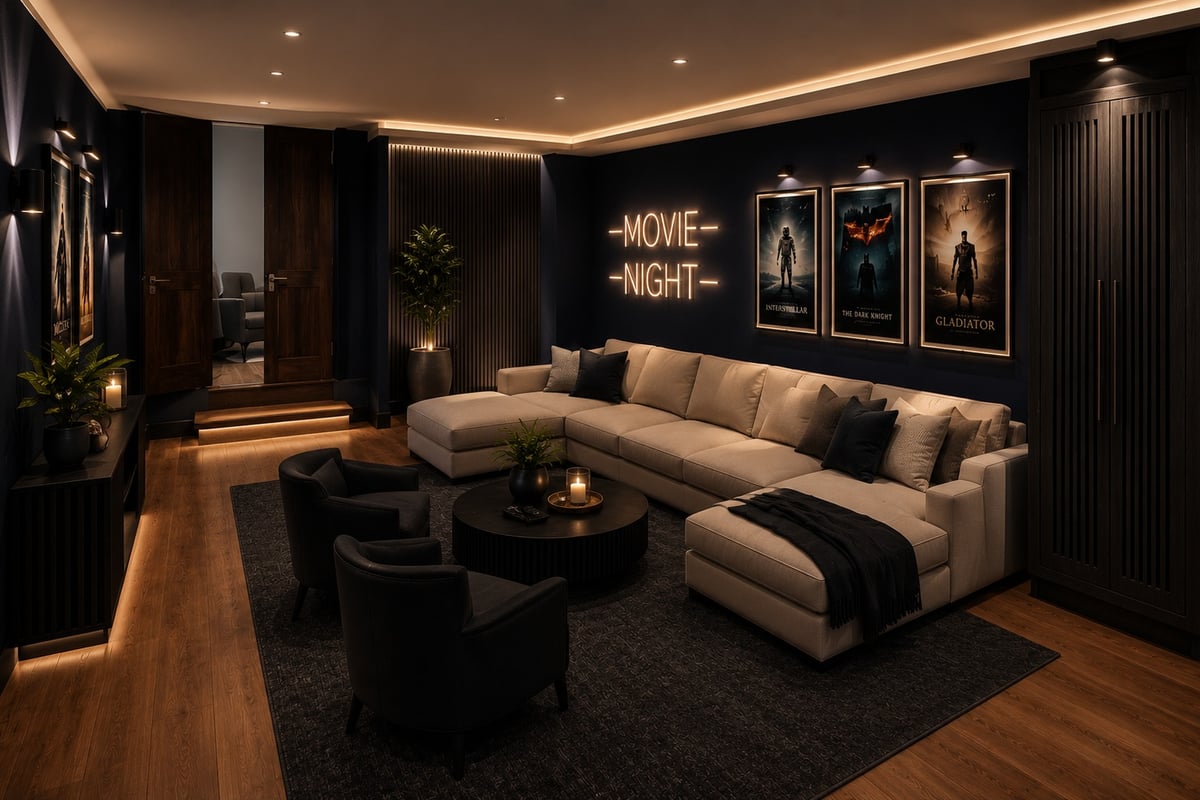
Bass Management and Subwoofer Calibration
Low frequencies interact strongly with room dimensions, creating peaks and nulls that vary dramatically across different seating positions. Proper subwoofer placement and calibration addresses these issues.
Multiple subwoofers placed asymmetrically smooth bass response better than a single sub. Automated room correction in your receiver helps, but manual adjustment using measurement equipment achieves superior results.
Power Management and Equipment Protection
Stable, clean power delivery protects your investment and ensures consistent performance from sensitive home theater components.
Power Conditioning Versus Surge Protection
Basic surge protectors guard against voltage spikes but do nothing for voltage sags, electrical noise, or total power loss. Power conditioners filter incoming AC, removing interference that can cause audible hum or video artifacts.
Uninterruptible power supplies (UPS) add battery backup, allowing graceful shutdown during outages and protecting against the voltage fluctuations common in many residential areas. Size your UPS to support critical components for 10-15 minutes of runtime.
Power system best practices:
- Dedicate electrical circuits to home theater equipment when possible
- Use hospital-grade outlets for better contact and reduced noise
- Install whole-house surge protection at the electrical panel
- Connect power amplifiers directly to wall outlets (some designs benefit from unfiltered power)
- Group components logically on separate zones of power conditioning
System Calibration and Optimization
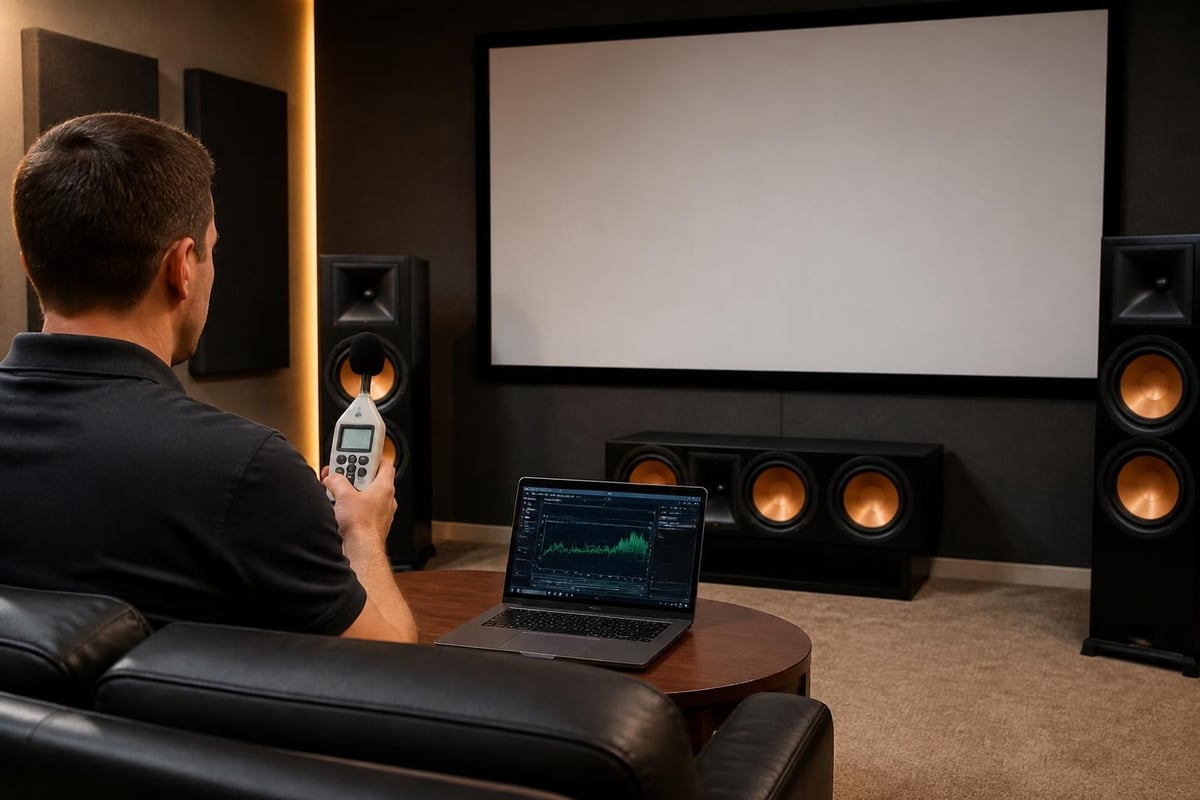
Extracting peak performance from your assembled home theater components requires methodical calibration. Building the perfect home cinema system involves both objective measurements and subjective adjustments.
Automated Room Correction Systems
Most modern receivers include microphone-based calibration systems. These technologies measure speaker distances, set crossover frequencies, adjust levels, and apply equalization to compensate for room acoustics.
Run automated calibration as your baseline, then verify the results. Automated systems occasionally make errors in speaker identification, distance calculation, or level setting. Manual verification prevents these mistakes from degrading performance.
Manual Fine-Tuning Techniques
After automated calibration, subjective adjustments personalize the system to your preferences. Speaker toe-in angle, subwoofer phase, and surround level trim all benefit from hands-on optimization.
| Parameter | Automated Setting | Manual Refinement |
|---|---|---|
| Speaker distances | Usually accurate | Verify with tape measure |
| Crossover frequencies | Conservative (80Hz) | Adjust based on speaker capabilities |
| Channel levels | Good baseline | Fine-tune for seat-to-seat balance |
| Subwoofer phase | 0° default | Adjust while listening to test tones |
| EQ curves | Room-dependent | Reduce excessive correction |
Objective measurements using tools like RTINGS speaker testing methodology provide insight into how your system actually performs versus manufacturer specifications.
Listening Tests and Content Selection
Use familiar reference material spanning different genres when evaluating your system. Well-recorded music reveals tonal balance and imaging, while action movies test dynamic range and surround envelopment.
Dialogue intelligibility matters most for many viewers. If you struggle to understand conversation at comfortable volumes, re-examine center channel placement, level calibration, and acoustic treatment around the seating area.
Scalability and Future Upgrades
Smart selection of home theater components allows incremental upgrades without replacing everything simultaneously. Plan for expansion even if budget constraints require phasing implementation.
Building a Flexible Foundation
Choose a receiver with more channels than you initially populate. A 9-channel AVR running a 5.1 system today easily expands to 7.1.2 Atmos when you add height speakers and surrounds.
Pre-wire for future speaker locations during construction or renovation. Running cables later costs significantly more and may prove impossible in finished spaces.
Upgrade Path Prioritization
When improving an existing system, sequence upgrades for maximum impact per dollar invested:
- Room acoustic treatment: Often the highest return on investment
- Subwoofer addition or upgrade: Dramatically improves impact and immersion
- Center channel speaker: The most important single speaker for movies
- Display upgrade: Most noticeable visual improvement
- Receiver replacement: Only when adding channels or formats
Quality speakers outlast most other home theater components. Premium models purchased today will likely serve through multiple receiver and display generations.
Integration With Whole-Home Systems
Modern installations extend beyond single-room setups, distributing audio and video throughout your home. Multi-room integration requires planning at the component selection stage.
Multi-Room Audio Distribution
Whole-home audio systems share music across multiple zones, with independent source selection and volume control in each room. Options range from simple multi-zone receivers to sophisticated platforms like Sonos, HEOS, or custom distributed audio.
Your main home theater can serve as the flagship zone in a larger ecosystem. Many AV receivers include multi-zone outputs that drive speakers in adjacent spaces while the main room plays different content.
Centralized Equipment Racks
Professional installations centralize home theater components in equipment closets or racks, keeping technology out of sight while improving ventilation and serviceability. HDMI and speaker cables run through walls to displays and speakers in living spaces.
Centralized designs require careful cable management, proper labeling, and adequate cooling. Equipment generates heat that must be exhausted to prevent thermal throttling or premature failure.
Selecting the right home theater components transforms your viewing space into an immersive entertainment environment that delivers years of enjoyment. The integration of quality audio, video, and control elements creates experiences that rival commercial cinemas while offering the comfort and convenience of home. Whether you're building a dedicated screening room or enhancing a living area, ANR media specializes in custom home cinema and audio video solutions tailored to your space, budget, and performance goals, from multiroom systems to complete bespoke cinema room conversions.