

The home cinema experience has evolved dramatically over the past decade, with wireless technology transforming how we approach surround sound installation. A 5.1 wireless surround sound system eliminates the cable clutter that once plagued home theater setups while delivering the immersive audio quality that defines true cinematic sound. This advancement allows homeowners to enjoy professional-grade audio without drilling through walls or running conduit across living spaces, making premium sound accessible to a broader range of spaces and architectural styles.
Understanding 5.1 Channel Configuration
A 5.1 wireless surround sound system consists of six discrete audio channels that work together to create a three-dimensional soundscape. The ".1" represents the dedicated low-frequency effects (LFE) channel, commonly known as the subwoofer, which handles frequencies below 120 Hz. The five main channels include a center speaker for dialogue, left and right front speakers for stereo imaging and music, and left and right surround speakers positioned to the sides or slightly behind the listening position.
This configuration became the industry standard because it matches how humans perceive directional sound in real environments. According to the Dolby speaker setup guidelines, the 5.1 layout provides optimal coverage for most residential viewing spaces between 150 and 400 square feet.
How Wireless Technology Integrates
Modern wireless transmission protocols have reached maturity levels that support high-resolution multichannel audio without the latency issues that plagued earlier systems. The WiSA Association has established standards for wireless speaker systems that ensure synchronized playback across all channels with imperceptible delay, typically under one millisecond.
Key wireless technologies used in 5.1 systems include:
- Proprietary 5 GHz radio frequency transmission
- WiSA-compliant wireless audio streaming
- Bluetooth with aptX HD or LDAC codecs (for specific implementations)
- Wi-Fi based transmission using dedicated network infrastructure
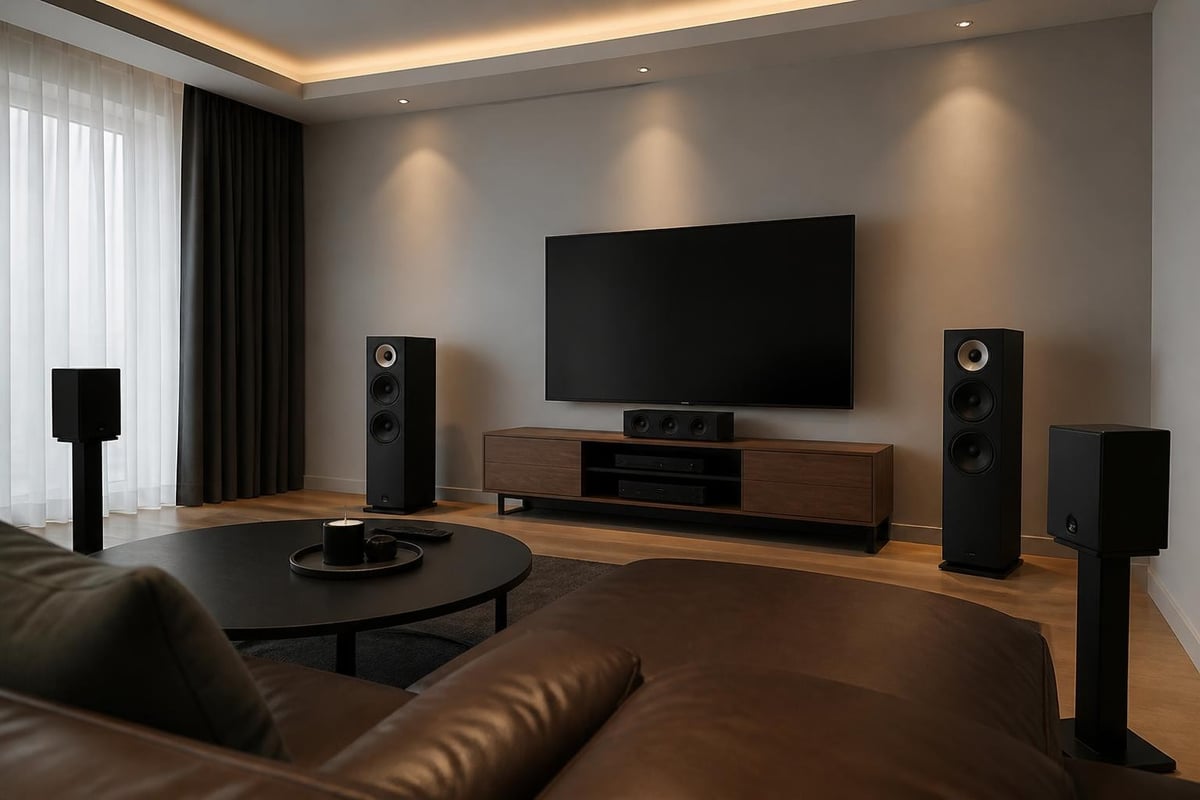
Each speaker in a wireless configuration contains its own amplifier and wireless receiver module, eliminating the need for speaker wire runs while maintaining individual channel control.
Audio Quality Considerations
The primary concern when evaluating any 5.1 wireless surround sound system centers on whether wireless transmission compromises audio fidelity. Current generation systems support lossless or near-lossless compression, preserving the dynamic range and frequency response of the original soundtrack.
Dolby Digital Plus supports bitrates up to 6 Mbps for 5.1 content, providing ample headroom for transparent encoding. High-end wireless systems operating on dedicated frequency bands can transmit uncompressed 24-bit/48kHz audio across all channels simultaneously.
Latency and Synchronization
Audio-video synchronization becomes critical in home cinema applications. While video processing in modern displays introduces 20-100 milliseconds of delay, wireless audio systems must account for transmission latency to maintain lip-sync accuracy. Premium wireless surround implementations achieve total system latency below 5 milliseconds, well within the threshold of human perception.
| Transmission Type | Typical Latency | Audio Quality | Best Use Case |
|---|---|---|---|
| Proprietary RF (5 GHz) | < 5 ms | 24-bit/96 kHz | Dedicated home cinema |
| WiSA Standard | < 1 ms | 24-bit/96 kHz | High-performance installations |
| Wi-Fi Multiroom | 20-50 ms | 16-bit/48 kHz | Casual listening, music |
| Bluetooth aptX HD | 40-70 ms | 24-bit/48 kHz | Portable, secondary systems |
The data demonstrates why professional installations favor dedicated wireless protocols over convenience-focused consumer technologies when audio-video synchronization matters.
Installation and Placement Strategies
Proper speaker placement remains as important in wireless systems as in traditional wired configurations. The elimination of cable runs provides flexibility to optimize acoustic positioning without being constrained by wire paths, but the fundamental principles of surround sound geometry still apply.
Optimal placement guidelines for a 5.1 wireless surround sound system:
- Center channel: Directly above or below the display, angled toward the primary listening position
- Front left/right: 22-30 degrees off-center from the main viewing position, at ear height when seated
- Surround left/right: 90-110 degrees from center, slightly elevated (1-2 feet above ear level)
- Subwoofer: Corner or boundary placement for room gain, or multiple subwoofer arrays for even bass distribution
The wireless advantage becomes apparent when architectural features like fireplaces, built-in cabinetry, or structural columns would complicate wire routing. Each speaker requires only AC power, dramatically simplifying retrofit installations in existing homes.
Power Management and Infrastructure
Every wireless speaker cabinet houses dedicated amplification, requiring individual power connections. Strategic placement of electrical outlets during planning phases prevents visible power cables from undermining the clean aesthetic wireless audio promises. In-wall power solutions or furniture-integrated outlets maintain the cable-free appearance.
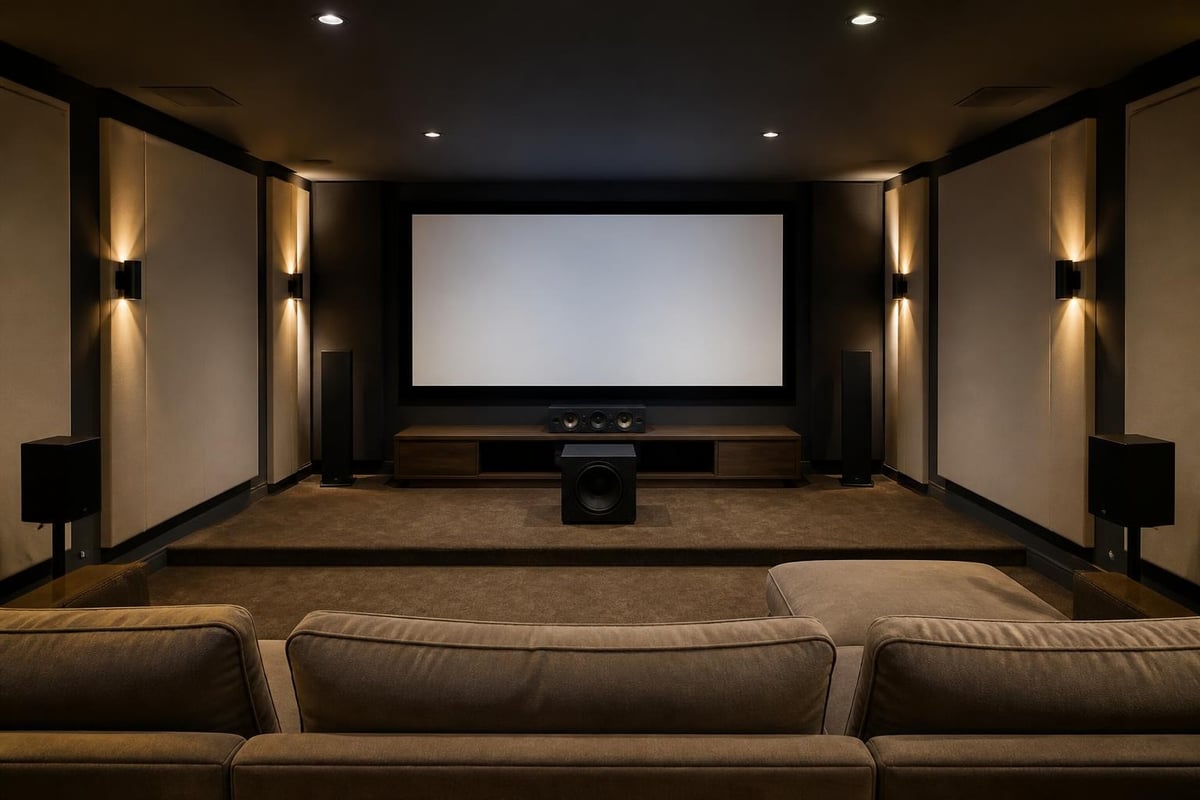
For those investing in a complete home entertainment space, ANR media's custom Home cinema room solutions integrate wireless surround systems within comprehensive acoustic and visual designs. These purpose-built environments account for speaker placement, power infrastructure, and room acoustics from the initial design phase, ensuring optimal wireless surround performance.
Source Compatibility and Signal Routing
A 5.1 wireless surround sound system requires proper signal routing from source devices through processing equipment to the wireless transmission hub. Modern AV receivers typically serve as the central processor, decoding incoming multichannel audio signals before distributing them to wireless speakers.
The Enhanced Audio Return Channel (eARC) specification enables displays to send high-bandwidth audio back to AV receivers, supporting uncompressed 5.1 and even object-based formats. This capability proves essential when streaming apps built into smart TVs generate the audio content.
Decoding Multichannel Formats
Common source formats include:
- Dolby Digital (AC-3): 640 kbps maximum, widely used in broadcast and streaming
- Dolby Digital Plus (E-AC-3): Up to 6 Mbps, standard for premium streaming services
- DTS Digital Surround: 1.5 Mbps, common in physical media
- PCM 5.1: Uncompressed multichannel, highest quality but largest bandwidth
The AV receiver or wireless hub must decode these formats into discrete channel signals before wireless transmission. Some integrated wireless systems include decoding capabilities within the hub itself, while others rely on external processing.
According to technical testing by RTINGS, not all displays pass multichannel audio formats correctly, particularly when receiving signals from external HDMI sources. Understanding these compatibility factors prevents frustration during system commissioning.
Room Acoustics and Wireless Performance
Wireless transmission occurs independently of room acoustics, but the acoustic environment dramatically affects perceived system performance. Hard reflective surfaces create early reflections that smear stereo imaging and reduce dialogue intelligibility, while excessive absorption deadens the sense of spaciousness surround channels create.
The CEDIA RP-22 design guidelines recommend reverberation times between 0.2 and 0.4 seconds for dedicated home cinemas, with controlled first reflections and diffusion on rear walls. Wireless systems benefit from these same acoustic principles.
Acoustic Treatment Integration
Strategic acoustic treatment enhances the performance of any 5.1 wireless surround sound system:
- Absorption panels at first reflection points (side walls, ceiling)
- Bass traps in corners to control room modes and even subwoofer response
- Diffusion on rear walls to create envelopment without excessive absorption
- Ceiling treatments to control vertical reflections in rooms with low ceilings
The GSA P100 facilities standards provide authoritative guidance on room acoustic design, including target noise criteria and reverberation characteristics. While designed for institutional spaces, these principles translate directly to high-performance residential installations.
Calibration and System Optimization
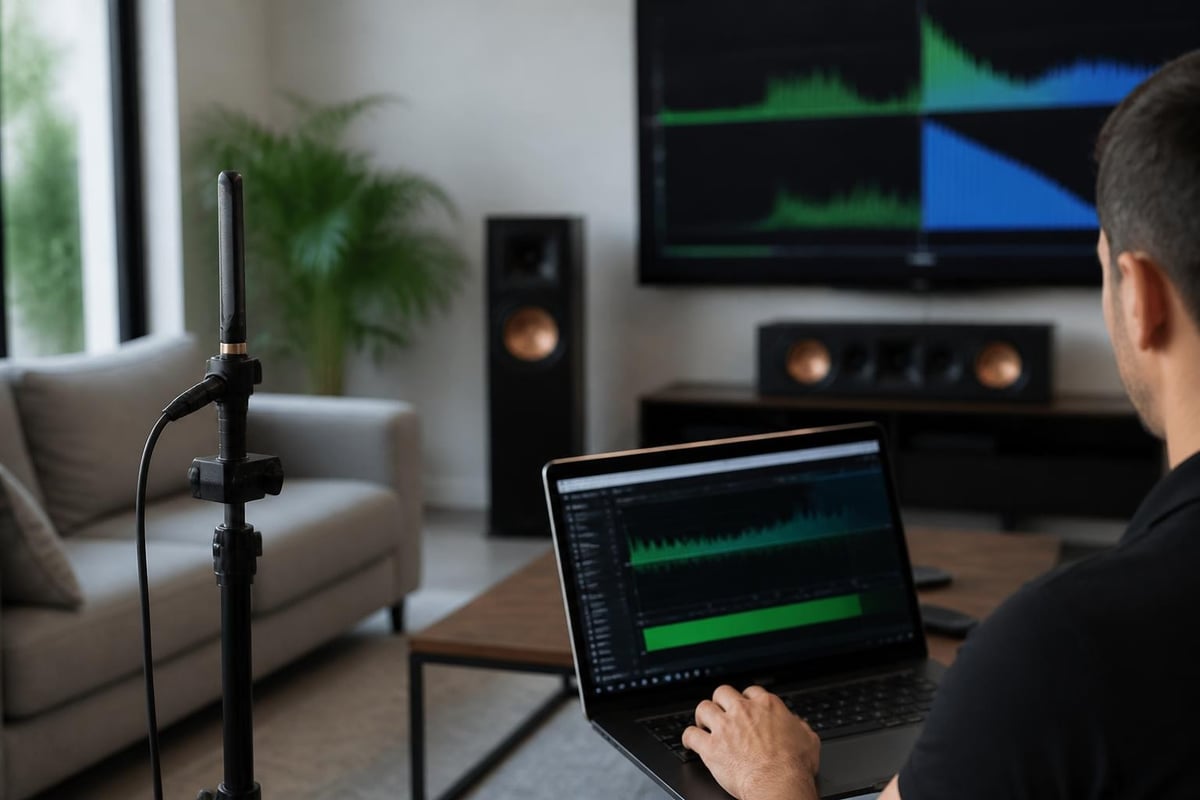
After physical installation, proper calibration extracts maximum performance from a 5.1 wireless surround sound system. Modern AV receivers include automated calibration routines that measure speaker distances, set individual channel levels, and apply equalization to compensate for room acoustics.
The calibration process typically includes:
- Microphone placement at the primary listening position
- Automated test tone generation for each speaker
- Distance and delay calculation based on acoustic arrival times
- Level matching using the ITU-R BS.1770-5 loudness standard
- Room correction equalization (when supported)
- Subwoofer integration and crossover configuration
Manual refinement often improves upon automated results. Experienced installers verify that center channel dialogue reproduction remains clear and natural, surround effects envelope the listening position without drawing attention to individual speakers, and bass integration creates seamless low-frequency extension.
Level Matching and Balance
Proper level matching between channels ensures that mixers' artistic intentions translate accurately to the playback environment. Film soundtracks assume specific relative levels between channels, with the center channel typically carrying dialogue 3 dB louder than music content in the front left/right pair.
The wireless nature of the system doesn't change these fundamental calibration requirements, but it does eliminate one common troubleshooting variable. Traditional wired systems can suffer from high-resistance connections, damaged wire, or reversed polarity. Wireless implementations remove these failure modes, though they introduce different considerations around RF interference and power stability.
Practical Advantages in Real Installations
The decision to implement a 5.1 wireless surround sound system often stems from practical considerations beyond pure audio performance. Retrofit installations in finished homes face significant challenges running speaker wire through completed walls and ceilings without visible damage or extensive patching.
Wireless systems transform difficult installations into straightforward deployments. Period homes with plaster walls, concrete construction, or decorative features become viable candidates for premium surround sound without compromising architectural integrity. The flexibility extends to rental properties where permanent modifications aren't permitted.
Scalability and Future Expansion
Many wireless surround platforms support modular expansion, allowing users to begin with a 5.1 configuration and add height channels for immersive formats later. This upgrade path provides investment protection as format standards evolve and user preferences develop.
The per-speaker amplification inherent in wireless designs also enables precise power matching. Each driver receives exactly the amplification it needs, rather than sharing a multi-channel amplifier across all speakers. This architectural advantage allows manufacturers to optimize power delivery and damping factor for each specific speaker design.
Comparison with Traditional Wired Systems
Understanding the tradeoffs between wireless and wired implementations helps determine the best approach for specific installations. Neither solution proves universally superior; each offers distinct advantages for different scenarios.
| Factor | Wired 5.1 System | Wireless 5.1 System |
|---|---|---|
| Installation complexity | High (requires wire runs) | Low (power only) |
| Retrofit feasibility | Difficult in finished spaces | Excellent |
| Audio quality potential | Excellent | Excellent (with quality systems) |
| Latency | None | < 5 ms (quality systems) |
| Upgrade flexibility | Limited by existing wire | Modular expansion supported |
| Initial cost | Lower (passive speakers) | Higher (active speakers) |
| Long-term reliability | Excellent | Good (depends on wireless tech) |
The cost difference primarily reflects the integrated amplification and wireless receivers each speaker requires. However, this comparison changes when factoring in professional wire installation labor for retrofit applications. Complex wire runs can exceed the price premium of wireless implementations.
Maintenance and Troubleshooting
A 5.1 wireless surround sound system requires minimal ongoing maintenance, but understanding common issues enables quick resolution when problems arise. The most frequent concerns involve wireless interference, power management, and firmware compatibility.
Common troubleshooting scenarios include:
- Intermittent audio dropouts: Usually caused by RF interference from routers, cordless phones, or neighboring systems
- Synchronization drift: Indicates firmware updates needed or battery backup issues in wireless modules
- Single channel failure: Points to power connection, speaker malfunction, or transmitter pairing loss
- Reduced dynamic range: May result from level calibration drift or wireless compression settings
Most quality wireless systems include diagnostic modes that display signal strength, latency measurements, and connection status for each speaker. These tools expedite troubleshooting and help identify environmental factors affecting performance.
Firmware and Software Updates
Manufacturers regularly release firmware updates that improve wireless protocols, add codec support, and resolve discovered issues. Maintaining current firmware across all system components ensures optimal performance and compatibility with evolving source formats.
The update process varies by manufacturer, ranging from automatic over-the-air updates to manual USB installation procedures. Establishing a regular maintenance schedule that includes firmware verification prevents compatibility issues before they affect system operation.
Integration with Multiroom Audio Systems
Many homeowners desire both dedicated home cinema surround sound and distributed audio throughout living spaces. Modern wireless platforms increasingly bridge these requirements, allowing a 5.1 wireless surround sound system in the primary viewing room to coexist with stereo or mono speakers in other zones.
Network-based wireless systems can leverage existing home infrastructure, routing different content to different zones while maintaining the low-latency multichannel performance cinema demands. This convergence eliminates the need for separate dedicated systems and simplifies control interfaces.
The technical challenge involves balancing the competing demands of multichannel synchronization (requiring low latency) and whole-home distribution (where modest delays prove acceptable). Quality implementations maintain separate signal paths for critical surround channels while using higher-latency, more efficient compression for background music zones.
Professional Installation Considerations
While marketed as user-installable solutions, 5.1 wireless surround sound systems benefit significantly from professional design and commissioning. Experienced installers understand acoustic principles, wireless RF behavior, and calibration techniques that optimize system performance beyond factory defaults.
Professional involvement proves particularly valuable when integrating wireless surround into comprehensive home automation systems, coordinating with lighting control, motorized shades, and video distribution. These complex installations require careful planning to prevent control conflicts and ensure seamless operation.
Custom installers also specify appropriate acoustic treatments, verify electrical infrastructure adequacy, and document system configurations for future service needs. The incremental investment in professional installation typically pays dividends through superior performance and long-term reliability.
A well-designed 5.1 wireless surround sound system delivers the immersive audio experience that defines premium home cinema while eliminating the installation complexity that once made surround sound accessible only to dedicated enthusiasts. The technology has matured to the point where wireless implementations match or exceed wired alternatives in most residential applications. Whether you're planning a dedicated home cinema or upgrading an existing living room system, ANR media brings the expertise needed to design, specify, and install wireless surround solutions that deliver professional-grade performance tailored to your specific space and requirements.