

The concept of a portable home theater has evolved dramatically from bulky equipment that barely qualified as "portable" to sleek, powerful systems you can carry in a backpack. Today's technology delivers cinema-quality visuals and immersive audio in packages light enough to take anywhere, transforming gardens, guest rooms, camping sites, and temporary venues into premium viewing spaces. Whether you're planning outdoor movie nights, creating flexible entertainment zones, or need a cinema solution that adapts to multiple locations, understanding the components and tradeoffs of portable systems will help you make informed decisions.
Understanding the Portable Home Theater Ecosystem
A portable home theater comprises four essential elements working in harmony: projection, screening surface, audio reproduction, and power delivery. Each component must balance performance against portability, with compromises that differ significantly from permanent installations.
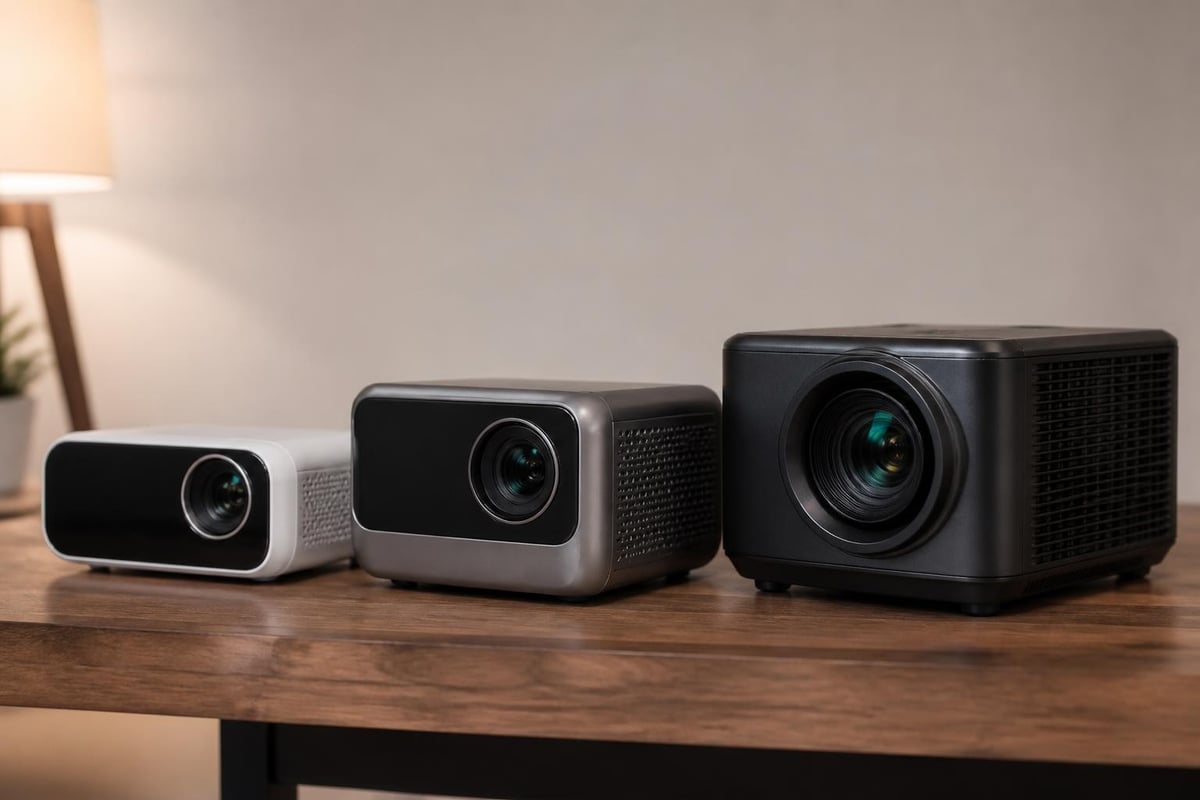
Modern portable projectors have closed the gap with traditional home cinema units in surprising ways. Brightness now reaches 1,000 to 3,000 ANSI lumens in battery-powered models, making daytime and ambient-light viewing practical. Resolution has standardized around 1080p as the baseline, with 4K units available for those prioritizing image detail over runtime and weight.
Key Performance Tradeoffs
When evaluating portable systems, three factors create the primary tension: brightness, battery life, and physical size. A projector delivering 2,500 lumens will drain batteries much faster than a 500-lumen unit, and both will be heavier than low-brightness alternatives.
| Feature | Compact Priority | Performance Priority | Balanced Approach |
|---|---|---|---|
| Weight | Under 2 kg | 3-5 kg | 2-3 kg |
| Brightness | 300-800 lumens | 2,000+ lumens | 1,000-1,500 lumens |
| Battery Runtime | 4+ hours | 1-2 hours | 2-3 hours |
| Resolution | 720p-1080p | 4K native | 1080p native |
The RTINGS portable projector reviews provide data-driven testing that quantifies these tradeoffs, measuring brightness uniformity, color accuracy, and input lag across dozens of models updated throughout 2026.
Projection Technology and Screen Solutions
DLP (Digital Light Processing) dominates the portable projector market due to its compact optical engine and excellent contrast ratios. LED and laser light sources have replaced traditional lamps entirely in 2026 portable units, offering 20,000 to 30,000 hours of maintenance-free operation and instant on/off capability.
The choice of screen material dramatically impacts image quality. Portable screens fall into several categories, each serving different deployment scenarios and performance requirements.
Portable Screen Types and Applications
Tripod and stand screens offer the fastest setup, typically deploying in under two minutes. They work well for presentations and casual viewing but can suffer from wrinkles and tension issues that affect image geometry. Most models top out at 120 inches diagonal, with 80 to 100 inches being the sweet spot for stability.
Inflatable screens create impressive displays for outdoor events, ranging from 12 to 30 feet diagonal. They require an electric pump and take 5 to 10 minutes to deploy fully. The ProjectorReviews screen buyer’s guide covers material choices, gain specifications, and aspect ratios that help match screens to your projector's capabilities and viewing environment.
- Tension-frame portable screens deliver the best image quality by keeping fabric perfectly flat
- Roll-up manual screens pack smallest but may show minor waves unless properly tensioned
- Rear-projection screens enable installations where front projection isn't practical
- Ambient-light-rejection materials maintain contrast in rooms with windows or lighting
White and gray screen materials serve different purposes. White maximizes brightness and works best in controlled lighting, while gray (0.8 to 1.2 gain) improves black levels and contrast when ambient light cannot be fully eliminated.
Audio Components for Mobile Cinema
Sound quality often determines whether a portable home theater feels like a true cinema experience or merely a large television. The spatial constraints and power limitations of portable setups require creative approaches to audio reproduction.
Wireless speakers have matured to the point where latency is no longer the dealbreaker it once was. Bluetooth 5.3 with aptX Adaptive or LC3plus codecs keeps audio-video sync within imperceptible thresholds for most content. However, dedicated 2.4 GHz or 5 GHz wireless systems still offer lower latency for gaming and critical listening applications.
Building a Portable Audio System
A 2.1 configuration (stereo speakers plus subwoofer) represents the minimum for cinematic sound in a portable context. Three-way designs that include dedicated midrange drivers deliver clearer dialogue and more detailed soundtracks than two-way designs at comparable size.
Battery-powered speakers with USB-C Power Delivery input can run for 6 to 12 hours at moderate volume levels. Understanding how to calculate battery runtime helps you plan power budgets across all components and avoid mid-movie shutdowns.
Soundbar alternatives provide integrated multi-channel processing in a single enclosure. The best portable soundbars include battery power, multiple HDMI inputs, and support for Dolby Atmos height virtualization. While they cannot match discrete speakers for soundstage width, they excel at simplicity and fast deployment.
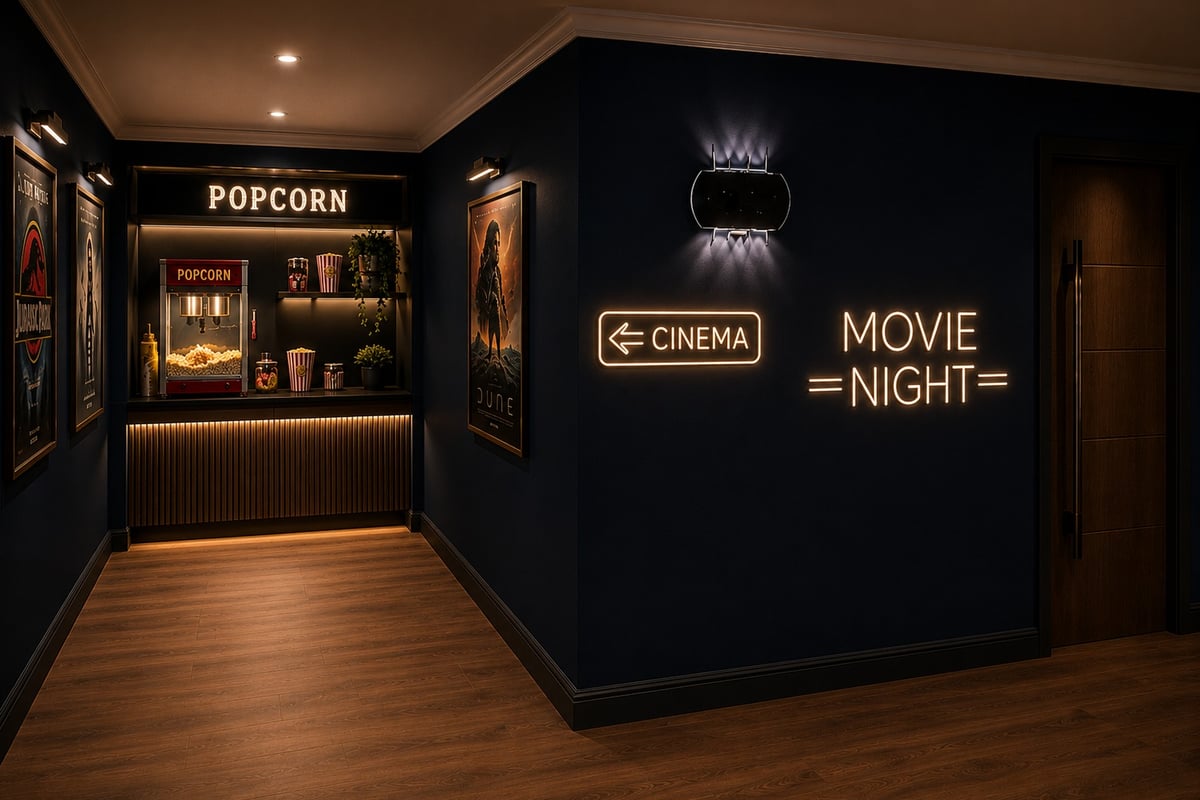
For clients seeking permanent installations that can also serve multiple rooms or outdoor spaces, the flexibility of a dedicated home cinema room design provides a foundation that portable components can complement. A properly designed permanent system with zone capabilities offers reference-quality performance in the main theater while supporting secondary viewing areas with portable equipment.
Connectivity and Source Integration
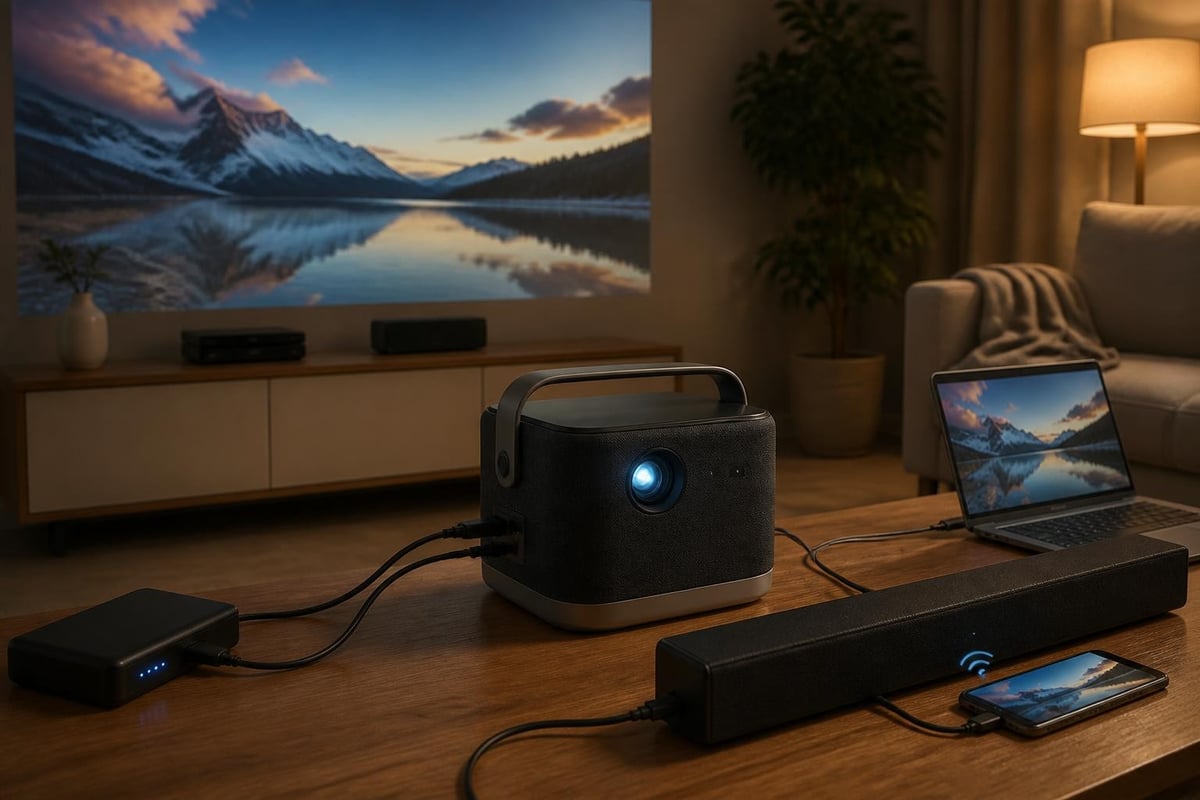
Modern portable home theater setups must accommodate diverse source devices: smartphones, tablets, laptops, streaming sticks, gaming consoles, and Blu-ray players. The USB-C connectivity standards have simplified this dramatically, with USB-C Alt Mode enabling video, audio, and power delivery through a single cable.
HDMI remains the standard for highest-quality video transmission, but ensuring your portable projector supports HDMI 2.1 features like eARC (enhanced Audio Return Channel) and ALLM (Auto Low Latency Mode) future-proofs your investment. The HDMI Type-C specification explains how newer devices can output full HDMI signals through USB-C ports, reducing cable clutter.
Wireless Casting and Streaming
Built-in Android TV, Google TV, or proprietary smart platforms eliminate the need for external streaming devices in many portable projectors. These systems integrate Wi-Fi 6 and support direct casting from iOS and Android devices via AirPlay 2 or Chromecast protocols.
- Direct device casting: Phone to projector without internet connectivity
- Cloud streaming: Netflix, Amazon Prime, Disney+, Apple TV+ directly on projector
- Local network playback: Access media servers and NAS devices over Wi-Fi
- Screen mirroring: Display exactly what appears on your smartphone or laptop
Network performance matters significantly for 4K streaming. Wi-Fi 6 (802.11ax) provides the bandwidth and reduced latency needed for multiple simultaneous 4K streams, essential when running a portable home theater alongside smart home devices and other network traffic.
Power Management and Runtime Planning
Power delivery represents the most significant limitation in truly portable setups. A high-brightness 4K projector might consume 150 to 250 watts, while audio systems add another 50 to 150 watts depending on volume and speaker efficiency. Battery capacity must support both components for your desired runtime.
Portable power stations have become the preferred solution for extended off-grid operation. These lithium battery systems offer AC outlets, USB-C Power Delivery ports, and DC outputs in a single package. Capacity ranges from 300Wh (sufficient for 90 minutes of moderate use) to 2,000Wh or more (supporting several hours of full-power operation).
Calculating Total Runtime
Total system power draw determines how long your portable home theater will run on battery. Add the consumption of all components at typical operating levels, then divide battery capacity by this number. Include a 20% safety margin to account for inverter efficiency and battery protection circuits.
A practical example: A 1,000Wh power station supporting a 120W projector and 80W audio system (200W total load) will provide approximately 4 hours of runtime (1,000Wh ÷ 200W = 5 hours, minus 20% = 4 hours). Plan for shorter sessions or bring backup batteries for all-day events.
| Power Station Capacity | Typical Runtime (150W Load) | Typical Runtime (250W Load) |
|---|---|---|
| 300Wh | 1.5 hours | 50 minutes |
| 500Wh | 2.5 hours | 1.5 hours |
| 1,000Wh | 5 hours | 3 hours |
| 2,000Wh | 10 hours | 6 hours |
Solar panel compatibility extends runtime indefinitely in outdoor settings with adequate sunlight. A 100W solar panel can add 300 to 500Wh per day in good conditions, effectively offsetting moderate daytime use or recharging overnight for evening sessions.
Acoustic Considerations for Temporary Spaces
Unlike permanent home cinema installations where room treatment and speaker placement can be optimized, portable setups often operate in acoustically challenging environments. Outdoor spaces lack reflective surfaces for sound reinforcement, while indoor temporary locations may have excessive reverberation or asymmetrical layouts.
Speaker positioning becomes a compromise between optimal acoustic placement and practical setup constraints. The AVIXA needs assessment guidance offers professional frameworks for evaluating space characteristics and adapting installation practices to temporary environments.
Optimizing Sound in Variable Environments
Outdoors, sound dissipates quickly without boundary reinforcement. Position speakers closer to the audience than you would indoors, and increase volume by 3 to 6 dB to compensate for the lack of room gain. Wind, ambient noise, and audience chatter all require additional headroom.
Indoors in untreated spaces, excessive reverberation can muddy dialogue and reduce intelligibility. Portable acoustic panels (2 to 4 inches thick mineral wool or foam) placed at first-reflection points dramatically improve clarity. Even a few strategically placed panels make a measurable difference.
Subwoofer placement matters less in portable contexts because low frequencies are less directional and room modes vary with each deployment location. Center placement between left and right speakers provides the most consistent results across different spaces.
Immersive Audio Formats in Compact Systems
Object-based audio formats like Dolby Atmos have moved beyond permanent installations into portable systems. While true overhead speakers remain impractical for most portable setups, height virtualization through psychoacoustic processing creates convincing vertical sound placement through ear-level speakers.
The Dolby Atmos technical white paper explains how object-based rendering adapts to available speaker configurations, from full 7.1.4 layouts down to stereo speakers with head-related transfer functions (HRTF) for virtual height.
Portable soundbars with Atmos support use upward-firing drivers and wall reflections to create height cues, an approach that works better in traditional rectangular rooms than outdoor spaces. For true portability with immersive audio, headphone-based spatial audio using head tracking provides the most consistent results regardless of deployment environment.
Use Cases and Application Scenarios
Different applications demand different balances of performance, portability, and battery life. Understanding your primary use case shapes every equipment decision.
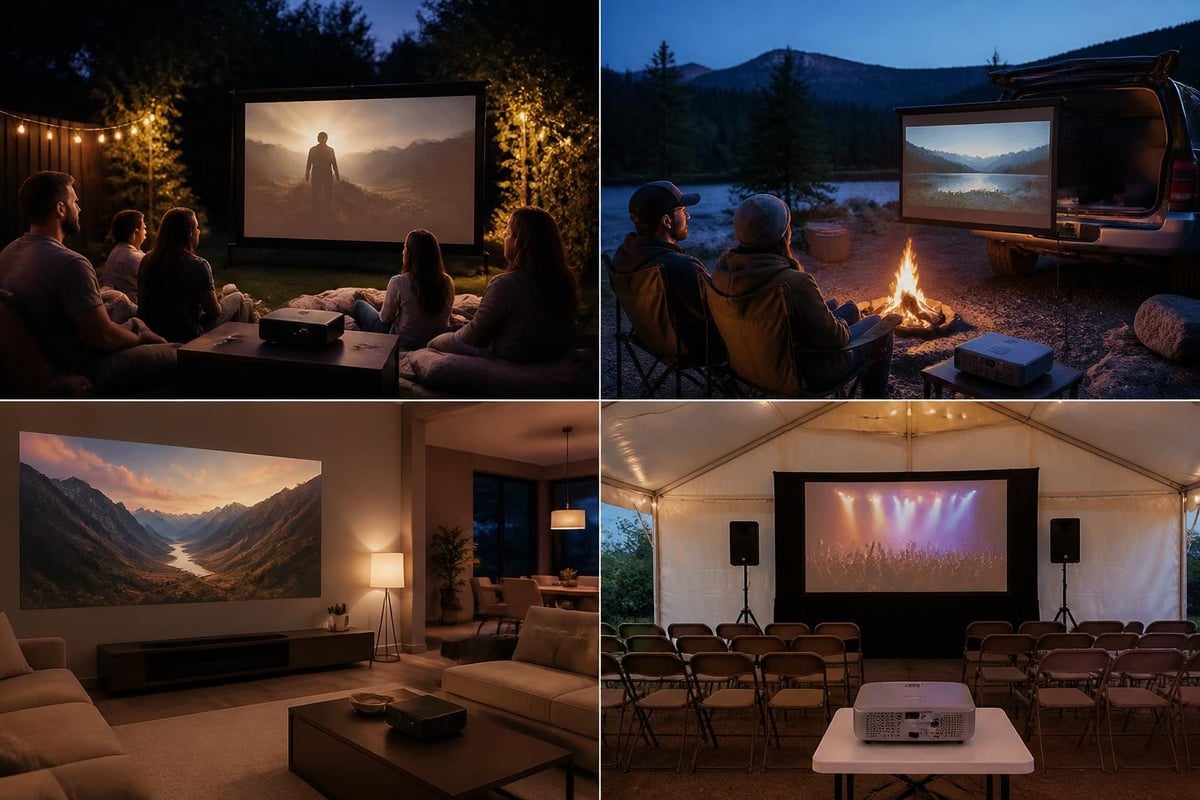
Backyard movie nights prioritize screen size and brightness over ultimate portability. A 150-inch inflatable screen paired with a 2,000-lumen projector and AC-powered audio system creates an impressive neighborhood cinema. Setup time of 15 to 20 minutes is acceptable when the system stays in one location for an evening.
Camping and outdoor adventures flip the priority to weight and battery efficiency. A 1.5-kilogram projector with 3-hour battery life, 80-inch tripod screen, and battery-powered Bluetooth speakers pack into a single backpack. Image quality takes a back seat to freedom from AC power and minimal carry weight.
Multi-room flexibility within a home benefits from semi-portable components. A ceiling-mounted roll-down screen in a guest room, combined with a compact projector stored in a cabinet, transforms the space for movie nights without permanent equipment. The same projector can move to the patio or basement as needed.
Temporary venue installations for events, presentations, or pop-up theaters demand professional-grade performance in portable packages. These applications often have AC power available, allowing heavier equipment with superior brightness and sound quality while maintaining the flexibility to deploy in different venues.
Future-Proofing Your Portable Investment
Technology evolution happens faster in portable electronics than in permanent installations. Buying decisions should account for format support, connectivity standards, and upgrade paths that extend useful life beyond the typical 3 to 5 year replacement cycle.
8K content remains niche in 2026, but 4K has become the baseline for premium portable projectors. HDR10 and Dolby Vision support ensure compatibility with current streaming content, while HLG (Hybrid Log-Gamma) matters for broadcast HDR sources.
Gaming features like 120Hz refresh rates, variable refresh rate (VRR), and sub-20ms input lag position your portable home theater for PlayStation 6, Xbox, and PC gaming applications. These capabilities add minimal cost today but significantly expand usage scenarios.
Battery technology continues advancing, with solid-state batteries promising 40 to 60 percent higher energy density by 2028. For equipment purchased in 2026, replaceable battery packs protect against capacity degradation and allow future upgrades to higher-capacity cells without replacing the entire unit.
Integration with Smart Home Systems
Portable home theater components increasingly integrate with broader smart home ecosystems. Voice control through Alexa, Google Assistant, or Siri enables hands-free operation, while automation platforms like Home Assistant or Control4 can trigger entire deployment sequences.
A sophisticated automation might detect that you've started a movie on your portable projector, then automatically dim smart lights, close motorized shades, adjust thermostat temperature, and switch audio inputs on your soundbar. When the movie ends, lights fade back up gradually and climate control returns to normal settings.
Scene-based control proves especially valuable for portable setups that change location. "Movie Night" scenes remember your preferred volume level, picture mode, and lighting state, then apply them consistently whether you're watching in the living room, guest bedroom, or backyard.
Maintenance and Storage Considerations
Portable equipment experiences more wear than permanently installed gear due to repeated setup, transport, and environmental exposure. Protective cases and proper storage extend component life significantly.
Hard-shell cases with custom foam inserts protect projectors, speakers, and accessories during transport. The foam should support equipment without pressure points that might damage buttons or input jacks. Moisture-absorbing packets prevent condensation damage during storage in climate-controlled areas.
Lens cleaning matters more for portable projectors that see dust and fingerprints. Use only microfiber cloths and projector-specific cleaning solutions. Never use glass cleaners containing ammonia, which can damage lens coatings and projection optics.
Screen materials require different care depending on type. Mildew-resistant fabrics work best for outdoor screens that might encounter dew or rain. Store screens loosely rolled rather than tightly coiled to prevent permanent creases. Inflatable screens should be fully dried before deflating and packing to prevent mold growth.
Battery maintenance extends pack life substantially. Store lithium batteries at 40 to 60 percent charge rather than fully charged or depleted. Avoid temperature extremes (below 0°C or above 35°C) during storage, and cycle batteries at least once every three months to maintain cell balance and capacity.
Professional Setup Services and Custom Solutions
While portable home theater equipment emphasizes DIY setup, complex installations benefit from professional calibration and integration. Color calibration ensures accurate image reproduction across different ambient light conditions. Audio tuning adapts speaker output to specific deployment environments and compensates for room acoustics.
Custom solutions bridge the gap between fully portable and permanently installed systems. Ceiling-recessed screens that deploy electrically but retract when not in use preserve room aesthetics while delivering premium image quality. In-wall speakers with magnetic grilles maintain a clean appearance but can be supplemented with portable components for outdoor use.
For clients ready to invest in a reference-quality installation that can also support flexible usage, a fully equipped home cinema room establishes a permanent foundation while allowing portable components to extend that experience to other areas. Professional design ensures every element works together seamlessly.
Building a portable home theater in 2026 offers unprecedented flexibility without sacrificing the cinema-quality experience that makes movies, sports, and gaming truly immersive. By carefully balancing performance requirements against portability needs and understanding the technical tradeoffs inherent in mobile systems, you can create entertainment experiences that adapt to any space. Whether you're planning occasional outdoor movie nights or need a sophisticated system that moves between locations, ANR media brings decades of home cinema expertise to help design, integrate, and optimize your ideal portable or permanent theater solution.