

Creating an exceptional home theater audio experience requires careful planning, quality components, and proper installation. Whether you're converting a spare room into a dedicated cinema space or upgrading an existing entertainment system, understanding the fundamentals of audio reproduction will help you make informed decisions. Modern home theater audio systems combine precision engineering with acoustic science to deliver soundtracks with the same impact and clarity intended by filmmakers, bringing the cinema experience directly into your living space.
Understanding Home Theater Audio Configurations
The foundation of any home theater audio system begins with channel configuration. The standard notation uses three numbers: the first indicates main channels, the second represents subwoofers, and the third (when present) denotes height channels for immersive audio formats.
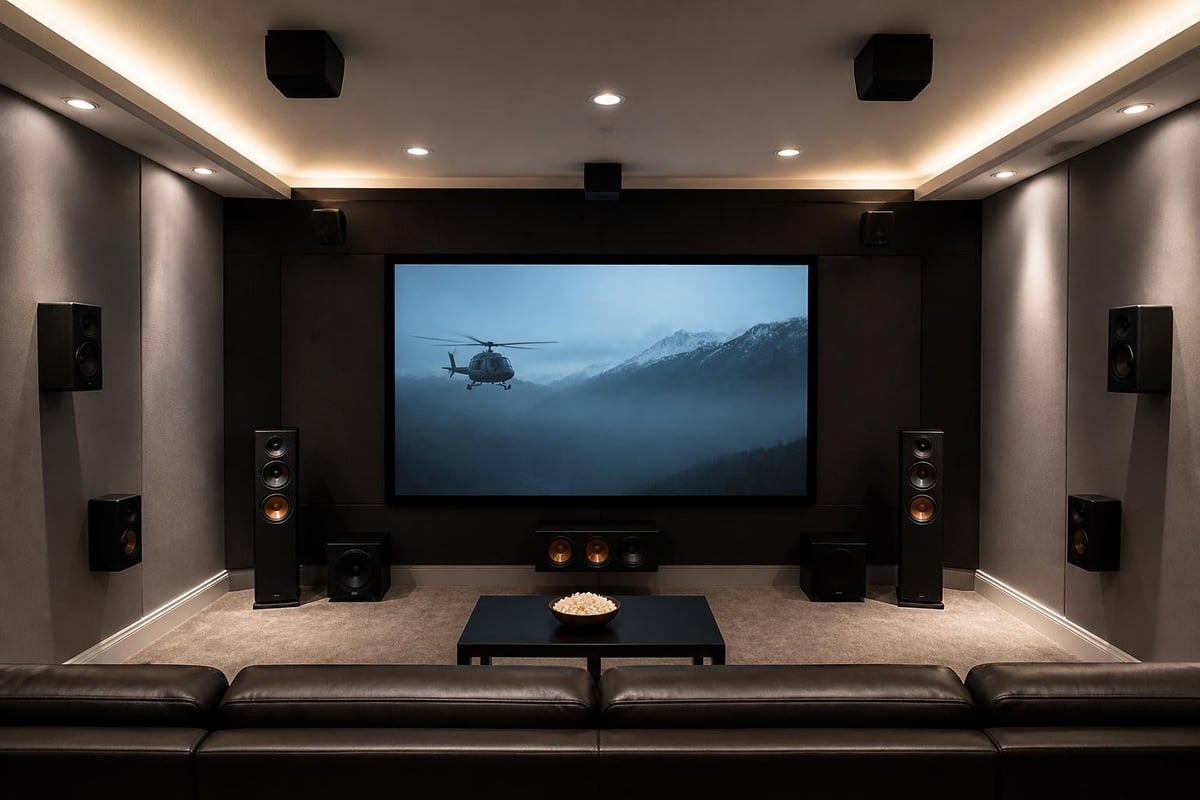
A 5.1 system remains the entry point for dedicated home theater audio, featuring left, center, and right front speakers, two surround speakers, and one subwoofer. This configuration has served as the foundation for home cinema sound for decades. The center channel handles dialogue, making it arguably the most critical speaker in your system.
Expanding to Immersive Audio Formats
Moving beyond traditional surround sound, Dolby Atmos and DTS:X have revolutionized home theater audio by adding height information to the soundstage. These object-based audio formats allow sound designers to place specific audio elements anywhere in three-dimensional space.
Common Atmos configurations include:
- 5.1.2: Entry-level Atmos with two height channels
- 5.1.4: Four height speakers for improved overhead imaging
- 7.1.4: Additional surround channels plus four height speakers
- 9.1.4: Reference-grade configuration with wide front channels
The Dolby Atmos speaker setup guide provides detailed placement specifications for each configuration, ensuring optimal performance from your chosen layout.
Speaker Selection for Home Theater Audio
Choosing the right speakers dramatically impacts your home theater audio performance. Cinema-specific speakers differ significantly from general-purpose audio speakers, designed to handle dynamic movie soundtracks with minimal distortion at high output levels.
Key specifications to evaluate:
- Sensitivity rating (higher numbers require less amplifier power)
- Frequency response (how low and high the speaker reproduces)
- Power handling (continuous and peak wattage)
- Impedance (typically 4, 6, or 8 ohms)
Matching Speakers Across Channels
Timbre matching ensures seamless sound transitions as audio pans across your home theater audio system. Using identical speakers from the same manufacturer's line for your front left, center, and right channels creates a coherent front soundstage.
Your center channel deserves special attention since it reproduces 60-70% of a film's soundtrack, primarily dialogue. Many installations compromise by using a smaller center speaker, but matching it to your main left and right speakers yields superior results.
| Speaker Type | Priority Level | Key Characteristics |
|---|---|---|
| Center Channel | Critical | Clear dialogue, wide dispersion, timbre-matched to mains |
| Front L/R | Critical | Full-range, dynamic capability, precise imaging |
| Surround | High | Diffuse soundfield, mounting flexibility |
| Height | Medium-High | Overhead localization, compact form factor |
| Subwoofer | Critical | Deep bass extension, room pressurization |
Subwoofers handle the low-frequency effects (LFE) channel and bass management from other speakers. Multiple subwoofers smooth room modes and create more even bass distribution throughout the seating area. Dual subwoofers represent a significant upgrade over single-sub configurations.
Amplification and Processing
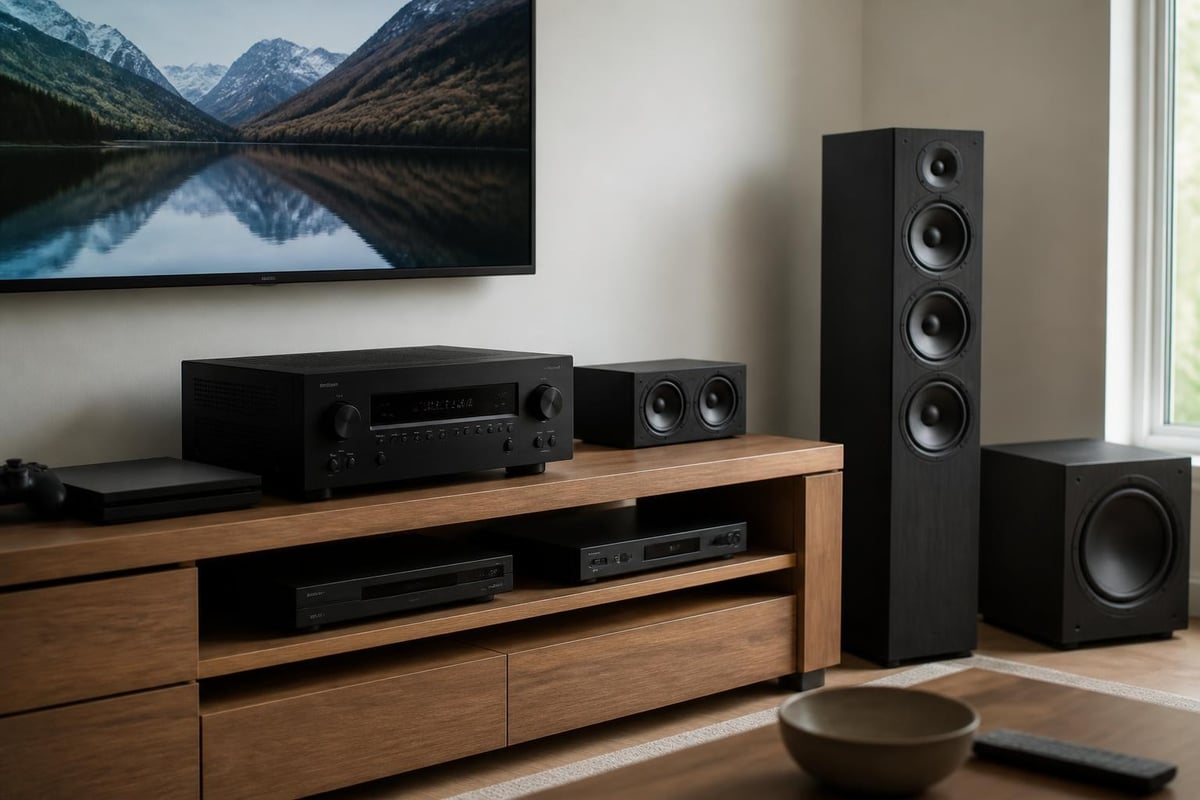
Your AV receiver or processor serves as the brain of your home theater audio system, decoding multichannel audio formats and distributing signals to appropriate speakers. Modern receivers handle complex tasks including bass management, room correction, and format decoding.
Essential amplification considerations:
Power output should match your speakers' requirements and room size. A common mistake involves under-powering speakers, which leads to distortion and potential damage. Calculate approximately 20-30 watts per channel for small rooms, 50-100 watts for medium spaces, and 100+ watts for larger dedicated theaters.
Separating processing from amplification offers advantages for demanding installations. A dedicated processor handles audio decoding and video switching, while external amplifiers deliver clean power to speakers. This approach provides superior performance and future upgradeability.
Room Correction Technology
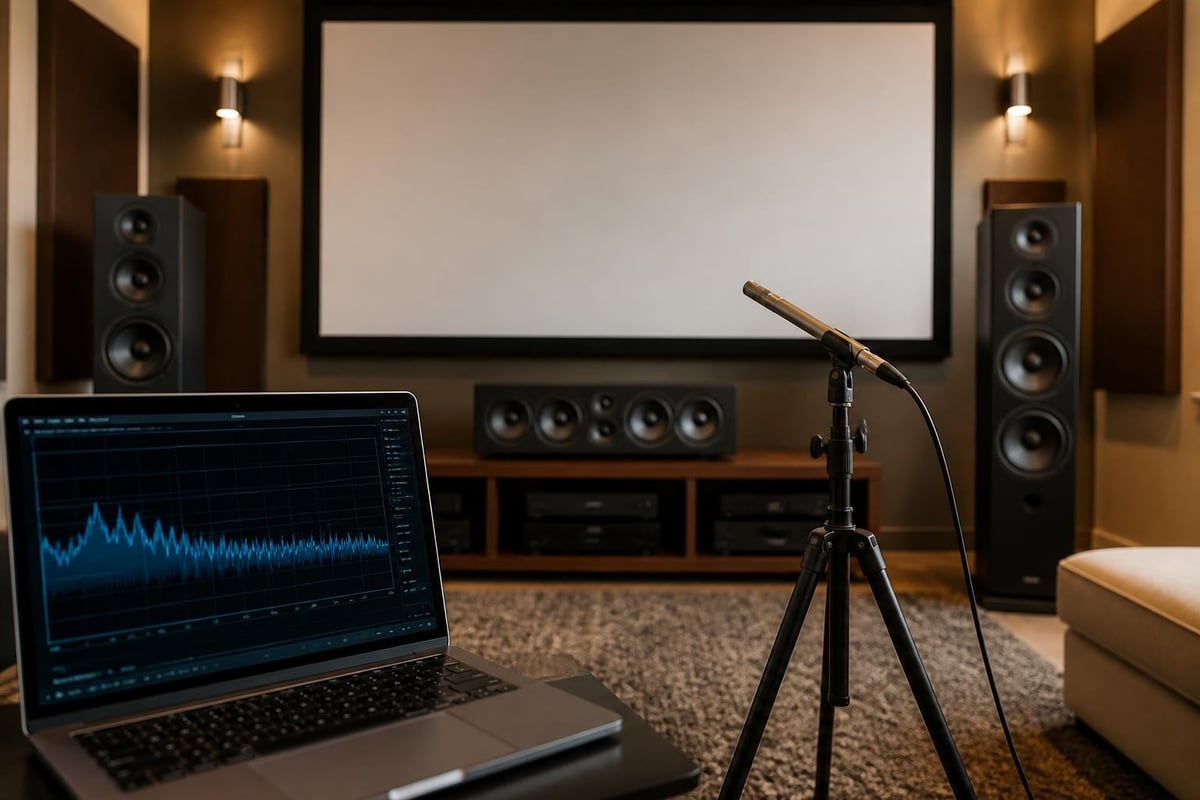
Automatic room correction systems measure your space's acoustic properties and apply digital signal processing to compensate for room-induced problems. Technologies like Audyssey, Dirac Live, and Anthem Room Correction analyze speaker response at multiple listening positions.
These systems cannot fix fundamental acoustic problems like severe flutter echo or excessive reverberation, but they effectively address frequency response irregularities and optimize speaker distances and levels. Professional calibration builds upon automatic correction for reference-grade performance.
Acoustic Treatment Fundamentals
Even premium home theater audio components cannot overcome poor room acoustics. Sound waves interact with room boundaries, furniture, and surfaces in complex ways that either support or degrade audio quality.
Primary Acoustic Challenges
Reverberation occurs when sound reflects repeatedly off hard surfaces, creating a muddy, indistinct soundfield. Excessive reverberation obscures dialogue clarity and reduces the precision of your home theater audio system.
Room modes are standing waves that create peaks and nulls at specific frequencies, particularly in the bass range. These modal issues cause uneven bass response depending on listening position.
Flutter echo happens when parallel reflective surfaces create rapid repetitive reflections, producing a distinctive ringing quality on transient sounds.
The GIK Acoustics guide to home theater acoustic treatment offers comprehensive strategies for addressing these common problems with absorbers, diffusers, and bass traps.
Treatment Strategies
Acoustic panels placed at first reflection points reduce early reflections that interfere with direct sound from speakers. These locations include sidewalls between speakers and listeners, ceiling bounce points, and the wall behind the listening position.
Bass traps in room corners address low-frequency modal problems. Corner placement proves most effective since room modes concentrate energy in these locations. Thick, dense absorbers work better for bass frequencies than thin panels.
| Treatment Type | Placement | Primary Function |
|---|---|---|
| Broadband Absorbers | First reflection points | Reduce mid/high frequency reflections |
| Bass Traps | Corners (tri-corners preferred) | Control low-frequency room modes |
| Diffusers | Rear wall, ceiling | Scatter reflections, maintain liveliness |
| Ceiling Clouds | Above seating | Reduce overhead reflections |
Installation Best Practices
Proper installation separates mediocre home theater audio from truly exceptional performance. Even high-quality components underperform when poorly positioned or incorrectly calibrated.
Speaker Placement Principles
- Center channel: Position at or near screen height, aimed toward the primary listening position
- Front left/right: Form equilateral triangle with main listening position, typically 22-30 degrees from center
- Surround speakers: Place slightly above ear level, 90-110 degrees from center position for 5.1 systems
- Height channels: Follow manufacturer spacing guidelines, typically 2-4 feet from listening position
The CEDIA recommended practice for immersive audio documents professional installation standards, including detailed speaker placement zones and performance grades for various room configurations.
Subwoofer placement requires experimentation due to room-specific acoustic properties. The "subwoofer crawl" technique involves temporarily placing the subwoofer at your listening position, playing bass-heavy content, and crawling around the room's perimeter to identify locations with smoothest bass response.
Cable Management and Connectivity
Quality cables matter, but expensive exotic cables rarely provide audible improvements over well-constructed standard cables. Focus budget on speakers and electronics rather than thousand-dollar cable looms.
Essential cabling guidelines:
- Use 14-gauge or thicker speaker wire for runs under 50 feet
- Maintain consistent polarity across all speakers
- Separate power cables from signal cables to minimize interference
- Label all connections for future troubleshooting
HDMI cables carry both video and audio in modern home theater audio systems. For runs exceeding 15 feet, consider active HDMI cables or fiber-optic HDMI solutions to ensure reliable 4K and 8K video transmission alongside high-resolution audio formats.
Advanced Optimization Techniques
Beyond basic installation, several advanced techniques extract maximum performance from your home theater audio system. These refinements separate good systems from exceptional ones.
Multi-Point Calibration
Professional installers calibrate systems from multiple seating positions rather than optimizing for a single sweet spot. This approach creates a larger area of excellent sound quality, benefiting all viewers rather than just the center seat.
Measure and adjust each position independently, then apply averaged corrections that benefit the entire seating area. Some advanced processors allow position-dependent corrections, applying different curves based on detected listener location.
Boundary Interference Response
Speaker placement relative to room boundaries significantly affects bass response. Each boundary (floor, walls, ceiling) reinforces bass output by approximately 3dB. A speaker placed in a corner receives reinforcement from three boundaries, creating a potential 9dB boost.
This reinforcement isn't inherently problematic, but it must be accounted for during calibration. Understanding boundary effects helps predict bass behavior and informs speaker placement decisions in your home theater audio design.
Dynamic Range Management
Movie soundtracks feature enormous dynamic range, from whisper-quiet dialogue to explosive action sequences. While this range creates impact in properly designed rooms, it may overwhelm typical living spaces or disturb others in the home.
Dynamic range compression reduces the difference between loud and soft passages without completely eliminating impact. Most AV receivers offer "late night" or "dynamic range" modes that apply intelligent compression. Use these features judiciously, as excessive compression defeats the purpose of high-quality home theater audio.
Integration with Video Systems
Modern home theater audio integrates seamlessly with video components through HDMI connections carrying both picture and sound. Understanding audio extraction and routing ensures compatibility across various source devices.
HDMI Audio Return Channel (ARC) allows your TV to send audio back to your AV receiver, eliminating separate audio cables for built-in TV apps. The newer eARC standard supports high-bitrate formats including Dolby Atmos and DTS:X that standard ARC cannot transmit.
Gaming systems benefit from low-latency audio processing to maintain synchronization between on-screen action and sound effects. Enable "game mode" or reduce video processing to minimize delay between controller input and audio response.
Streaming devices now deliver Dolby Atmos and other advanced formats through apps like Netflix, Disney+, and Apple TV+. Verify your entire signal chain supports the desired format, as a single incompatible component breaks the chain and forces downgrade to basic surround sound.
Custom Installation Considerations
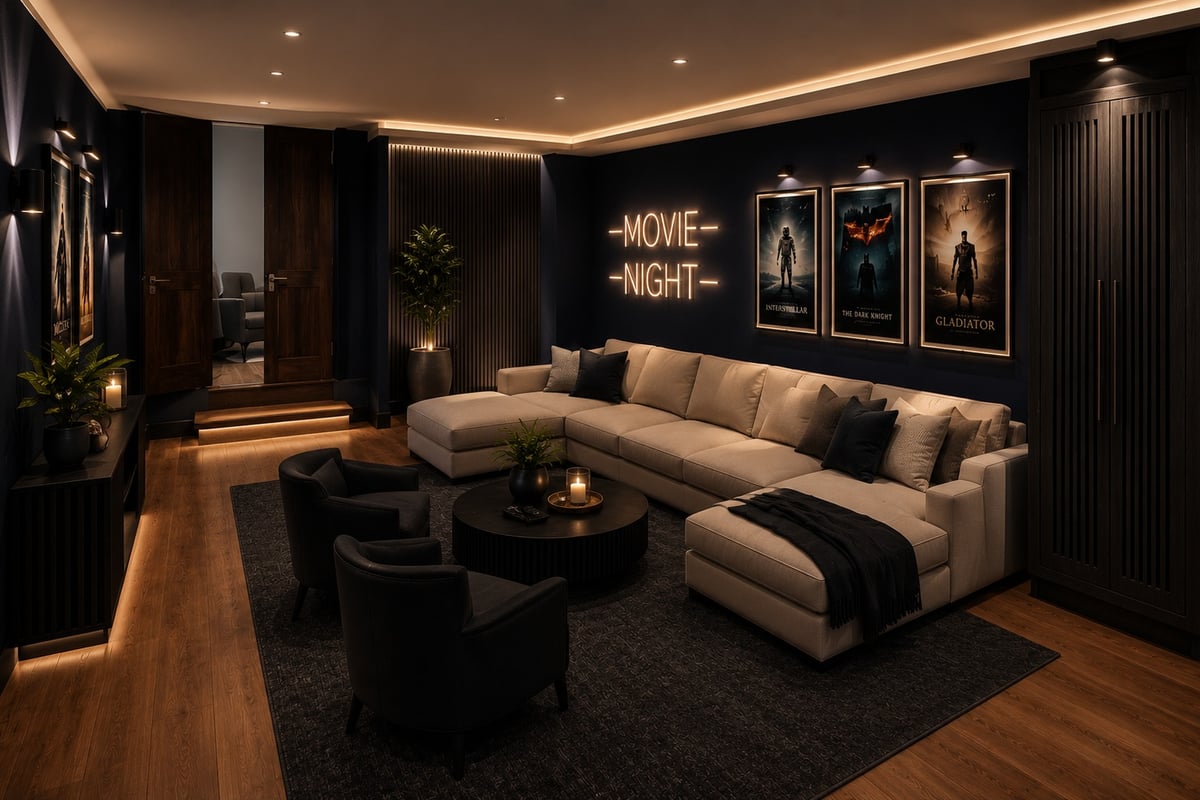
Dedicated home theater rooms allow complete control over acoustics, lighting, and equipment placement. For those investing in purpose-built spaces, several design elements deserve careful consideration.
Designing a custom home cinema room involves acoustic isolation to prevent sound transmission to adjacent spaces while blocking external noise from entering. This requires decoupled wall and ceiling construction, solid-core doors with seals, and attention to HVAC ducting paths. ANR Media specializes in complete home cinema room conversions that address these complex integration challenges, offering custom solutions from multiroom audio distribution to fully bespoke theater installations that optimize every aspect of your home theater audio experience.
Room dimension ratios affect modal behavior. Certain dimensional relationships create more even bass response than others. The Golden Ratio (1.0 : 1.6 : 2.6 for height : width : length) represents one of several mathematically derived optimal proportions, though real-world constraints often prevent perfect ratios.
Ceiling height influences both acoustics and immersive audio effectiveness. Heights of 9-12 feet work well for most home theater audio installations, providing adequate separation between listener and overhead speakers while maintaining reasonable room volume.
Seating and Viewing Geometry
Seat placement affects both audio and video quality. Position primary seating within the center 60% of room length to avoid bass null zones near room boundaries while maintaining appropriate screen viewing distance.
Riser heights for multi-row seating should provide clear sightlines over front-row viewers. A 12-inch rise per row typically suffices, though verify actual head heights with intended seating. Elevated rows also affect surround speaker placement, requiring adjustment to maintain proper ear-level positioning.
Format Compatibility and Future-Proofing
The home theater audio landscape continues evolving with new formats and delivery methods. Building flexibility into your system protects your investment against obsolescence.
Current immersive formats include Dolby Atmos, DTS:X, and IMAX Enhanced. While Dolby Atmos dominates theatrical releases and streaming content, DTS:X offers similar capabilities with different technical approaches. Most modern receivers decode all major formats.
Emerging considerations:
- Higher channel counts (beyond 7.1.4) for larger rooms
- Wireless speaker options for simplified installation
- Integration with smart home control systems
- Voice control compatibility
- Spatial audio for gaming platforms
The Dolby Professional home Atmos resource provides technical specifications and future roadmap information for installers and enthusiasts planning long-term home theater audio investments.
Modular system design allows component upgrades without complete replacement. Choosing an AV processor with pre-outs enables amplifier upgrades independently of processing capabilities. Similarly, selecting speakers with adequate power handling provides headroom for future amplification improvements.
Professional Calibration Value
While automatic room correction delivers impressive results, professional calibration takes performance to reference levels. Trained technicians use precision measurement equipment and extensive experience to optimize every parameter.
Professional calibrators measure dozens of points throughout the listening area, creating detailed acoustic maps that reveal room-specific problems. They apply corrective EQ with surgical precision, addressing narrow problem frequencies while leaving clean response areas untouched.
Beyond frequency response, professionals optimize phase relationships between speakers, ensuring coherent sound arrival at listening positions. They fine-tune crossover points, adjust individual speaker delays with sub-millisecond precision, and verify proper channel assignments throughout your home theater audio system.
The investment in professional calibration typically represents 5-10% of total system cost but can dramatically improve performance, effectively upgrading your existing components without purchasing new equipment.
Building exceptional home theater audio requires balancing technical knowledge with practical installation skills and acoustic understanding. The principles outlined here provide a foundation for creating immersive, cinema-quality sound in residential spaces. Whether you're planning a modest surround sound upgrade or a comprehensive custom cinema installation, ANR Media brings specialized expertise in home theater audio design and installation, transforming your vision into reality with professional-grade solutions tailored to your space and requirements.