

A theater system transforms an ordinary room into an immersive entertainment environment that rivals commercial cinemas. Whether you're watching the latest blockbuster, streaming a concert, or gaming with friends, the right theater system delivers exceptional picture quality, powerful audio, and an experience that pulls you into the content. Building or upgrading a theater system requires careful planning across multiple disciplines: video display technology, audio engineering, acoustic treatment, and integration. This guide explores the essential components, design considerations, and professional installation practices that create world-class home cinema experiences.
Understanding Theater System Fundamentals
A theater system comprises multiple interdependent subsystems working in harmony. The video chain includes the source device, processing, and display. The audio path encompasses source decoding, amplification, and speaker reproduction. Control systems tie everything together, while the room itself-often overlooked-plays a critical role in final performance.
Core subsystems include:
- Video display (projection or flat-panel)
- Audio processing and amplification
- Speaker array (5.1, 7.1, Atmos configurations)
- Source components (media players, streaming devices)
- Control and automation
- Acoustic treatment and room design
- Seating and viewing environment
Modern theater systems have evolved significantly from simple 5.1 surround configurations. Today's installations often feature object-based audio formats like Dolby Atmos, 4K or 8K video resolution, HDR (High Dynamic Range) imaging, and sophisticated room correction technologies. The UHD Alliance’s HDR standards define image quality benchmarks that separate premium theater systems from basic setups.
Video Display Technologies
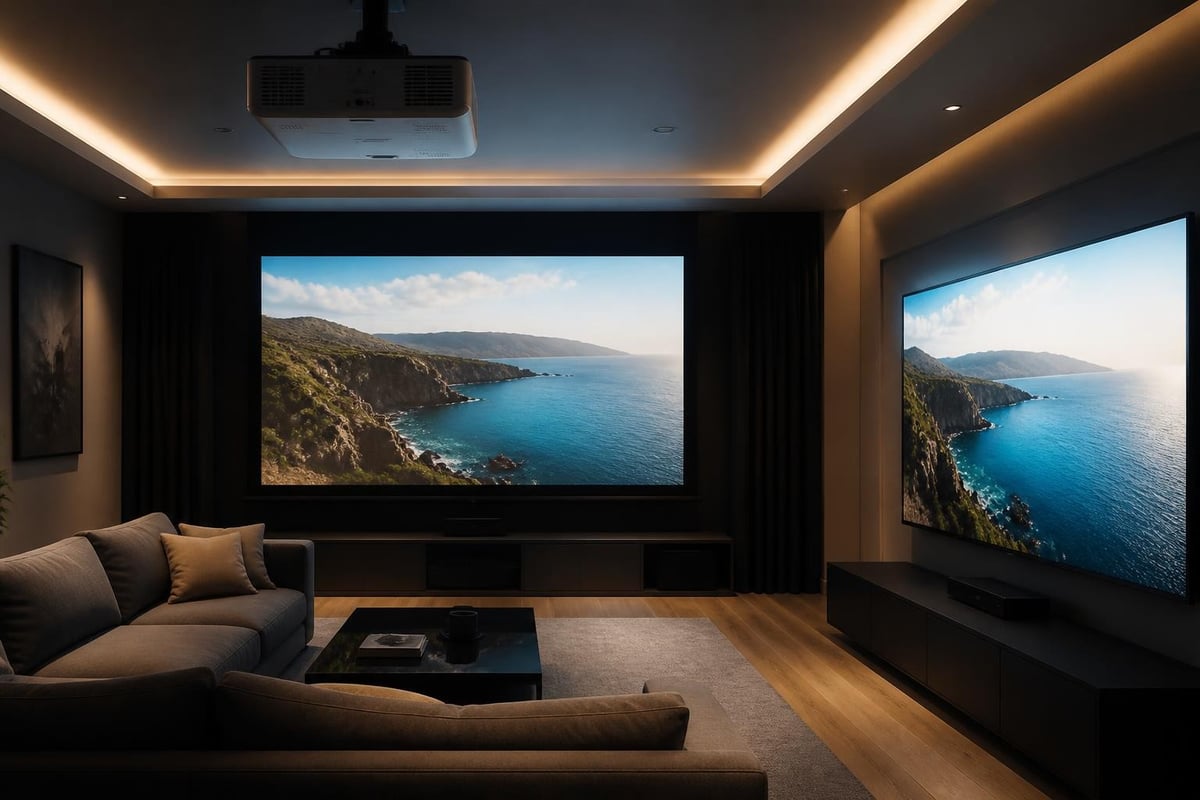
Choosing between projection and flat-panel displays represents the first major decision in theater system design. Projection systems excel in larger dedicated rooms, offering screen sizes from 100 to 200+ inches with true cinematic scale. Modern 4K projectors deliver exceptional brightness measured in lumens, with premium models reaching 3,000+ lumens for larger screens or rooms with ambient light.
Flat-panel displays-LED-LCD, OLED, or MicroLED-provide exceptional brightness, contrast, and convenience in sizes up to 100 inches. OLED technology offers perfect blacks and infinite contrast ratios, while MicroLED promises comparable performance with higher peak brightness and longer lifespan.
| Display Type | Ideal Screen Size | Peak Brightness | Contrast | Best Application |
|---|---|---|---|---|
| 4K Projector | 100-180 inches | 2,000-3,500 lumens | 2,000:1-1,000,000:1 | Dedicated dark rooms |
| OLED Panel | 55-88 inches | 700-1,000 nits | Infinite | Multi-purpose spaces |
| MicroLED | 80-146 inches | 1,500+ nits | 1,000,000:1+ | Premium installations |
| Laser Projector | 120-300 inches | 3,000-6,000+ lumens | 2,500:1-3,000,000:1 | Large venues, high ambient light |
The SMPTE standards for display quality provide technical benchmarks for color accuracy, resolution, and performance that separate professional-grade theater systems from consumer products. Screen gain, viewing distance, and throw ratio calculations ensure optimal viewing geometry.
Audio System Architecture and Speaker Configuration
Audio reproduction defines the immersive quality of any theater system. Traditional 5.1 and 7.1 channel configurations place speakers around the listening position, while modern Atmos systems add overhead channels for height information. The Dolby home theater setup guide provides detailed speaker placement recommendations that optimize soundstage and imaging.
Standard channel configurations:
- 5.1 Systems – Left, Center, Right, Surround Left, Surround Right, plus subwoofer
- 7.1 Systems – Adds Surround Back Left and Right channels
- 5.1.2 Atmos – 5.1 base with two height channels
- 7.1.4 Atmos – 7.1 base with four height channels
- 9.1.6 Atmos – Premium configuration with six overhead speakers
Speaker selection dramatically impacts theater system performance. In-wall and in-ceiling speakers provide clean aesthetics but require proper enclosure design. Freestanding speakers often deliver superior dynamics and bass extension. Cinema-specific speakers designed for theater applications offer controlled directivity, high efficiency, and the dynamic range needed for film soundtracks.
Amplification and Processing
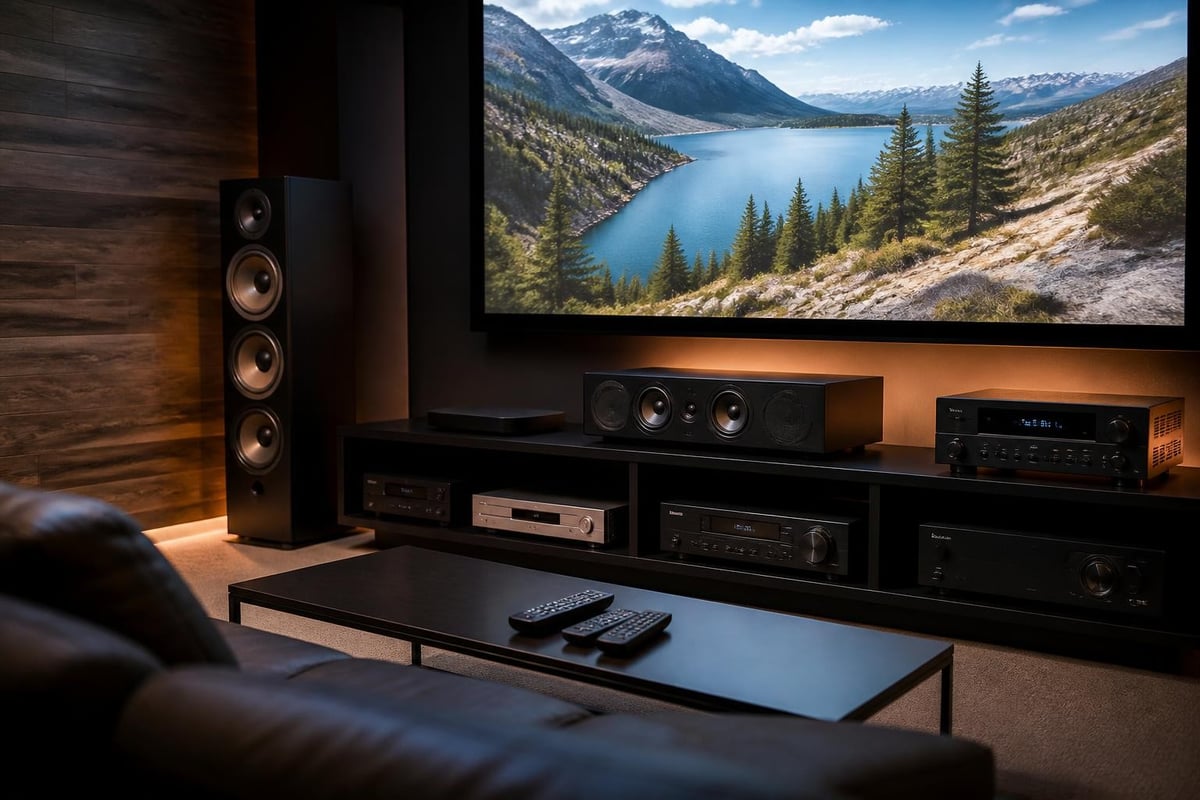
Separates-based systems use dedicated processors and amplifiers, offering superior performance and upgrade flexibility. The processor handles audio decoding (Dolby Atmos, DTS:X), bass management, room correction, and input switching. Multi-channel amplifiers provide the power-typically 100-300 watts per channel-needed to drive speakers to reference levels.
AV receivers combine processing and amplification in a single chassis, offering convenience and value for many installations. Premium receivers deliver 11-15 channels of processing with 9-11 channels of built-in amplification, supporting the most ambitious speaker layouts.
Room correction technologies like Dirac Live, Audyssey MultEQ XT32, and Trinnov Optimizer measure in-room response and apply filters to compensate for acoustic problems. These systems significantly improve tonal balance, imaging, and clarity. Room EQ Wizard provides measurement tools for detailed acoustic analysis and verification.
Room Design and Acoustic Treatment
The room itself represents half of a theater system's performance equation. Dimensions, surfaces, and acoustic treatment profoundly impact what you hear and see. Rectangular rooms with non-parallel walls minimize standing waves and flutter echo. Aspect ratios following Bolt's recommendations (length:width:height) reduce modal resonances.
Acoustic treatment priorities:
- Bass trapping in corners and boundaries
- First reflection point absorption
- Rear wall diffusion
- Ceiling treatment for overhead channels
- Blackout capabilities for projection
Professional theater system installations incorporate multiple treatment types. Absorption panels control reflections and decay time. Bass traps manage low-frequency resonances that cause uneven bass response and muddiness. Diffusion scatters sound energy, creating spaciousness without deadening the room.
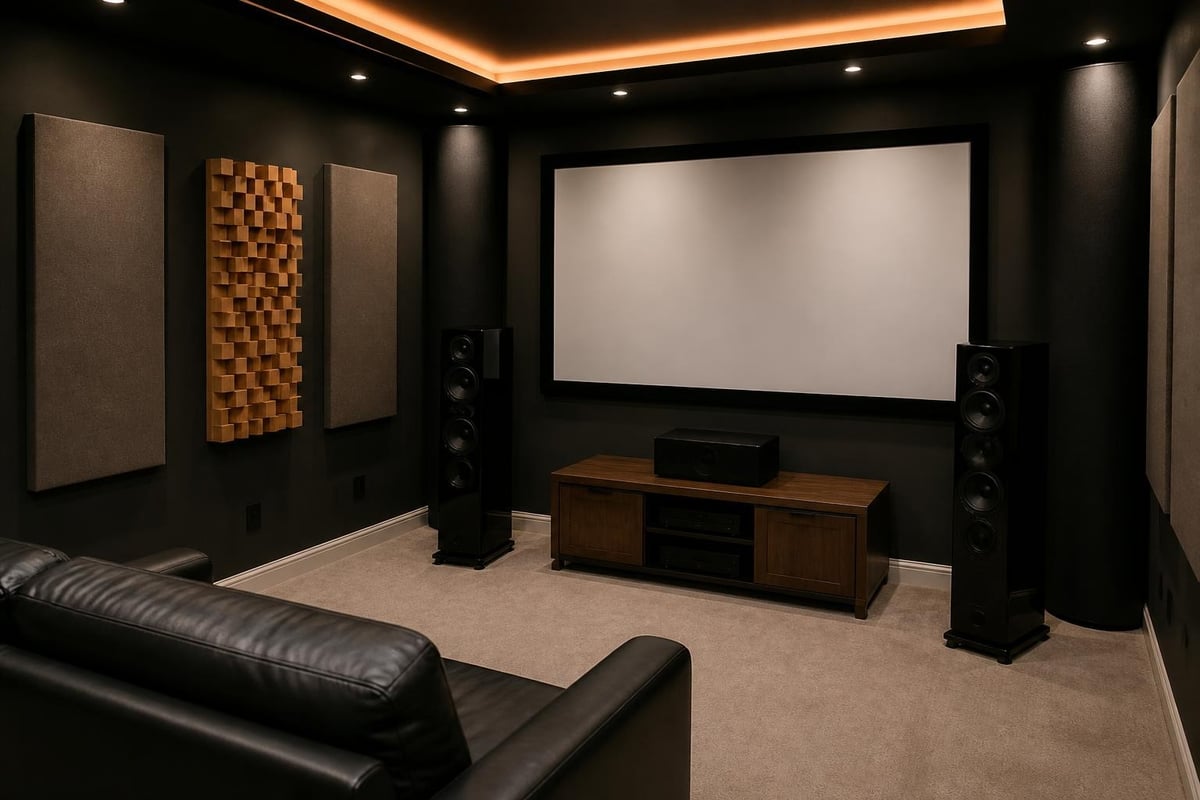
Surface materials matter tremendously. Carpet provides superior absorption compared to hardwood or tile. Fabric-wrapped walls reduce reflections. Heavy curtains control light and high frequencies. The goal is achieving 300-500ms reverberation time across the frequency spectrum-short enough for clarity, long enough to avoid an anechoic "dead" quality.
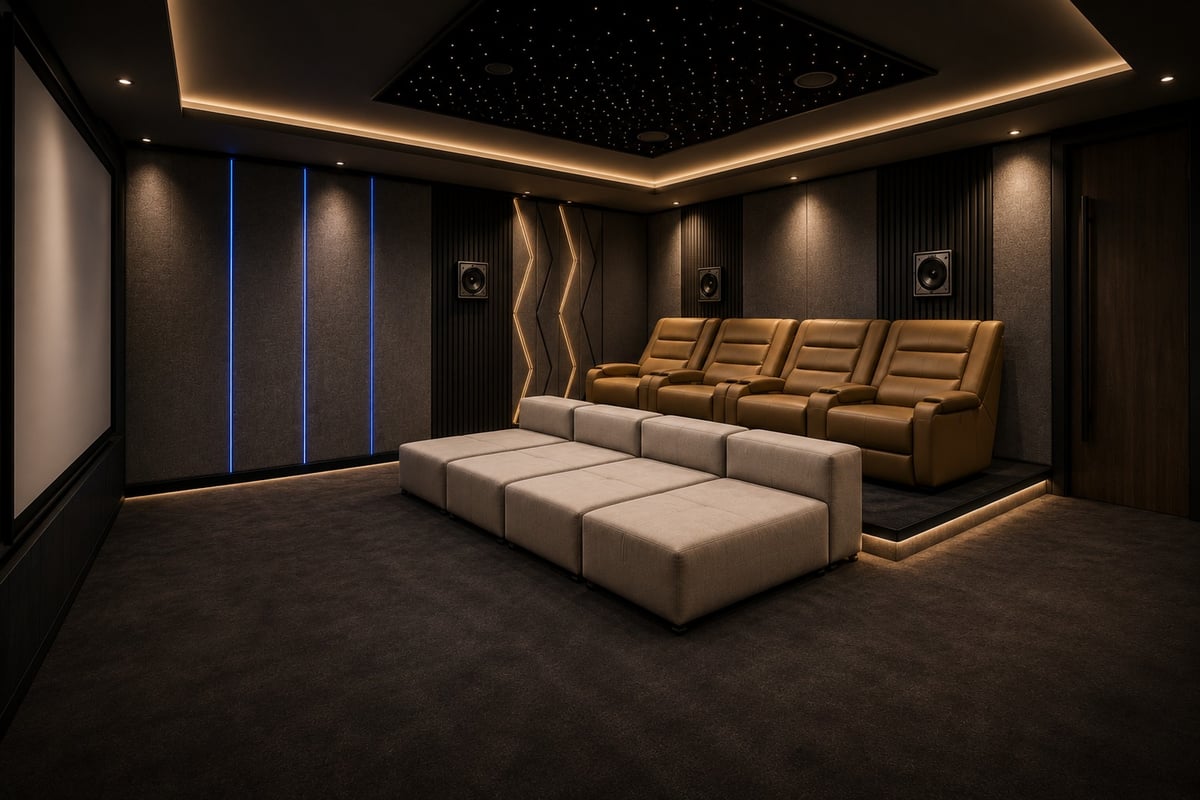
For those planning a dedicated space, a professionally designed Home cinema room addresses every aspect from structural isolation to acoustic treatment, integrating video, audio, and environmental controls into a cohesive, theater-grade experience. These turnkey solutions ensure proper geometry, treatment, and component integration from the start.
Integration and Calibration
Professional theater system integration extends far beyond connecting cables. Proper installation follows AVIXA standards for cable management, equipment mounting, ventilation, and documentation. Structured wiring in walls and ceilings maintains signal integrity while providing clean aesthetics.
Installation best practices include:
- Dedicated 20-amp circuits for amplifiers
- Conduit for future cable runs
- Equipment rack ventilation and cooling
- Professional-grade HDMI cables (certified 48Gbps for 8K)
- Speaker wire gauge appropriate for run length (12-14 AWG typical)
- Proper grounding to eliminate hum
Calibration transforms a collection of components into a cohesive theater system. Video calibration adjusts grayscale, gamma, color accuracy, and HDR tone mapping using professional meters and test patterns. Audio calibration sets levels, delays, crossovers, and equalization for flat frequency response and proper imaging.
Acoustic Measurement and Optimization
Professional calibration uses measurement microphones and software to analyze in-room response. Measurements at the main listening position and additional seats map spatial variation. Time-domain analysis reveals reflections and modal ringing. Frequency-domain measurements show response peaks, dips, and overall tonal balance.
The ITU-R BS.1770 standard defines reference levels for loudness calibration, ensuring content plays at the intended volume. Film soundtracks mixed to -31 LUFS reference should produce 85 dB SPL continuous with 105 dB peaks at the listening position when properly calibrated.
Source Components and Content Delivery
A theater system requires high-quality source components to realize its full potential. 4K Blu-ray players deliver the highest quality video and lossless audio formats (Dolby TrueHD, DTS-HD Master Audio). Streaming devices provide convenient access to Netflix, Disney+, Apple TV+, and other services, though compressed streams rarely match physical media quality.
Source considerations:
| Component | Video Quality | Audio Quality | Convenience | Cost |
|---|---|---|---|---|
| 4K Blu-ray Player | Excellent (100+ Mbps bitrate) | Reference (lossless) | Low | Medium |
| Streaming (4K) | Good (15-25 Mbps bitrate) | Good (lossy Atmos) | Excellent | Low |
| Gaming Console | Excellent (HDMI 2.1, 4K/120Hz) | Very Good | High | Medium-High |
| Media Server | Excellent (uncompressed) | Reference | Very High | High |
Media servers running Plex, Kodi, or JRiver store large libraries locally, providing instant access with quality matching or exceeding physical media. Network-attached storage (NAS) systems offer redundancy and expandability. Proper network infrastructure-gigabit Ethernet minimum-ensures smooth playback of high-bitrate content.
Control Systems and Automation
Sophisticated theater systems incorporate control systems that integrate lighting, shading, climate, and AV components. One-touch "movie mode" activates the projector, lowers the screen, dims lights, closes shades, and selects the media player. Custom interfaces on tablets, touchpanels, or smartphones provide intuitive control without juggling multiple remotes.
Programmable universal remotes offer simpler control integration. Macro commands trigger sequences of actions. Activity-based programming (Watch Movie, Play Game, Listen to Music) reconfigures the system for different uses. IP and RS-232 control protocols provide reliable communication with components.
Voice control through Amazon Alexa, Google Assistant, or Apple Siri adds convenience, though programming reliability varies. Integration with whole-home automation systems extends theater system control to security, climate, and other subsystems.
Professional Installation vs. DIY Approaches
Building a theater system involves decisions about professional installation versus self-installation. DIY approaches save labor costs and provide learning opportunities, but require significant time investment and risk suboptimal results. CEDIA’s guidance on choosing AV systems helps homeowners understand when professional integration adds value.
Professional integrators bring expertise in acoustics, calibration, construction coordination, and troubleshooting. They navigate complex HDMI handshake issues, optimize audio processing chains, and ensure systems meet performance specifications. Certified installers understand electrical code requirements for safe, compliant installations.
Professional installation provides:
- Acoustic design and treatment specification
- Proper equipment selection and sizing
- Structured wiring and infrastructure
- Calibration to reference standards
- Integration with home automation
- Warranty support and service
DIY-friendly theater system projects typically involve smaller rooms, simpler configurations, and more forgiving budgets. Even enthusiasts often benefit from professional consultation during design and calibration phases to avoid costly mistakes.
Maintenance and Future-Proofing
Theater systems require periodic maintenance to sustain peak performance. Projector lamps or laser modules have limited lifespans (2,000-20,000 hours depending on technology). Firmware updates address bugs and add features. Recalibration compensates for component drift and room changes.
Future-proofing strategies extend system longevity. Conduit for cable runs accommodates new formats. Modular component selection enables targeted upgrades. Processing separated from amplification allows processor replacement without changing amplifiers. Choosing current HDMI standards (HDMI 2.1 supporting 48Gbps bandwidth) ensures compatibility with emerging 8K content and high frame rate formats.
Technology evolution happens quickly in home cinema. 8K displays, wireless video transmission, spatial audio advances, and AI-driven processing represent coming developments. Building flexibility into theater system design through infrastructure planning and component modularity protects investments against obsolescence.
A well-designed theater system delivers years of exceptional entertainment through careful component selection, acoustic optimization, and professional integration. Whether you're planning a dedicated cinema room or enhancing a multi-purpose space, attention to fundamentals-proper speaker placement, acoustic treatment, calibration, and quality sources-separates truly immersive experiences from basic setups. ANR media specializes in custom home cinema design and installation, from multiroom audio solutions to bespoke theater room conversions that bring reference-quality cinema experiences into your home.