

The evolution of home entertainment has brought cinema-quality audio into residential spaces, and at the heart of this transformation lies surround sound technology. Unlike traditional stereo systems that deliver audio from two points, surround sound creates an immersive three-dimensional soundscape that envelops listeners from multiple directions. Whether you're designing a dedicated cinema room or upgrading an existing media space, understanding the principles, formats, and implementation strategies behind surround sound systems is essential for achieving professional-grade results in 2026.
Understanding Surround Sound Fundamentals
Surround sound operates on the principle of spatial audio reproduction, placing discrete audio channels at specific locations around the listening area. The technology mimics how humans naturally perceive sound in real environments, with audio cues arriving from different directions and distances.
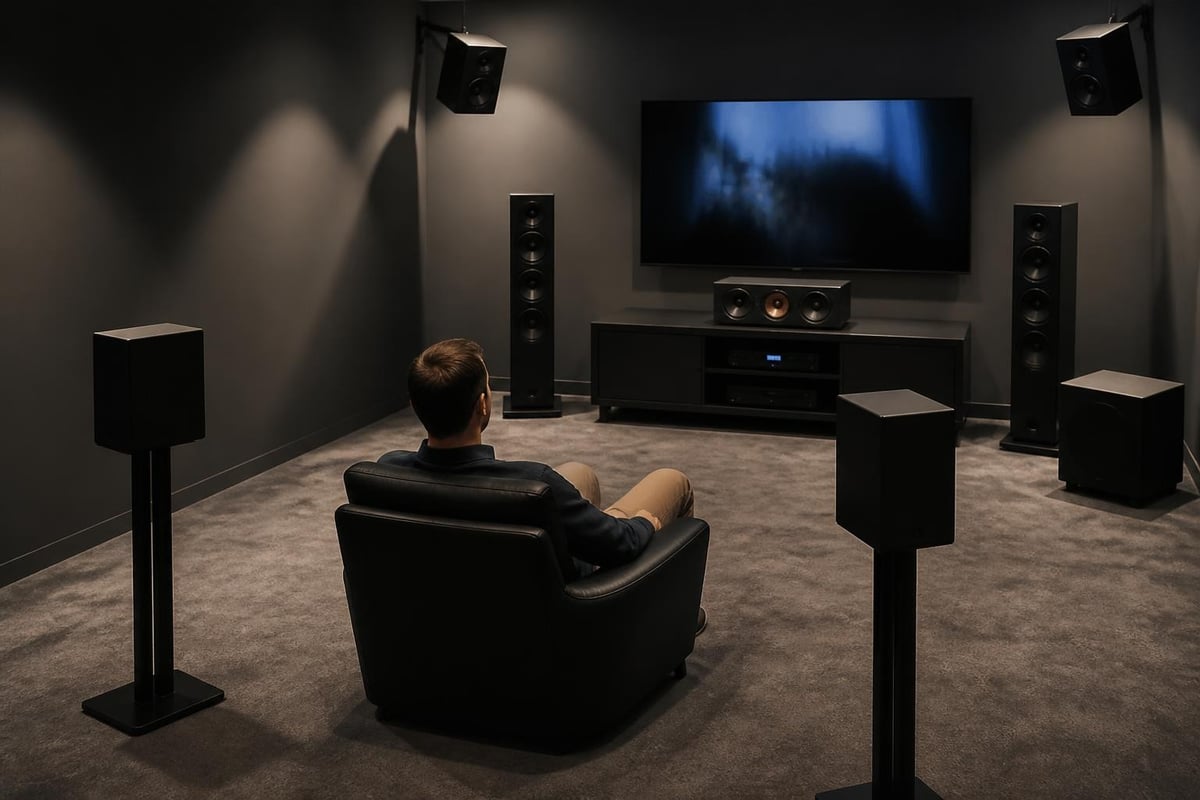
The most common surround sound configuration remains the 5.1 system, which includes five full-range speakers and one dedicated subwoofer channel. This layout features three front speakers (left, center, right), two surround speakers (left rear, right rear), and a low-frequency effects (LFE) channel handled by the subwoofer. The ITU-R Recommendation BS.775 provides the international standard for multichannel loudspeaker layouts, establishing precise angular positions for optimal sound reproduction.
Channel Configuration Basics
Modern surround sound systems use a numerical designation system that quickly communicates the speaker arrangement. The first number indicates full-range channels, the second represents subwoofers, and optional third and fourth numbers denote overhead or height channels.
Common surround sound formats include:
- 5.1: Five speakers plus one subwoofer (standard home theater)
- 7.1: Seven speakers plus one subwoofer (enhanced rear imaging)
- 5.1.2: Five speakers, one subwoofer, two height channels (entry-level immersive)
- 7.1.4: Seven speakers, one subwoofer, four height channels (premium immersive)
- 9.1.6: Nine speakers, one subwoofer, six height channels (reference-level installation)
The transition from traditional surround sound to immersive formats represents the most significant advancement in spatial audio since the introduction of multichannel systems. Height channels add a vertical dimension, creating a true three-dimensional sound field that can precisely position audio objects anywhere in the listening space.
Audio Formats and Codec Technologies
The surround sound experience depends equally on the encoding format and the playback system. Different formats employ varying approaches to storing and transmitting multichannel audio information, each with specific advantages for particular applications.
Dolby Digital (AC-3) established the foundation for consumer surround sound in the 1990s and remains widely used for broadcast and streaming content. This lossy compression format efficiently delivers 5.1 channels while maintaining acceptable audio quality for most listeners. Dolby Digital Plus extends the original format with support for higher bit rates and up to 7.1 channels, becoming the standard for streaming platforms.
DTS (Digital Theater Systems) offers an alternative codec family with generally higher bit rates than equivalent Dolby formats. DTS-HD Master Audio provides lossless compression for Blu-ray releases, preserving the original studio master quality without any degradation.
Object-Based Immersive Formats
The latest generation of surround sound technologies moves beyond fixed channel assignments to object-based audio rendering. Rather than mixing audio into predetermined channels, sound engineers assign audio elements as objects with associated spatial metadata.
Dolby Atmos leads the immersive audio category for home cinema applications. The system renders up to 118 simultaneous audio objects across the available speaker layout, calculating the optimal output for each speaker in real-time. Professional Dolby Atmos documentation explains how this object-based approach creates more precise spatial imaging than traditional channel-based systems.
| Format | Type | Maximum Channels | Compression | Primary Use |
|---|---|---|---|---|
| Dolby Digital | Channel-based | 5.1 | Lossy | Broadcast, streaming |
| Dolby TrueHD | Channel-based | 7.1 | Lossless | Blu-ray |
| Dolby Atmos | Object-based | 7.1.4+ | Varies | Cinema, streaming, Blu-ray |
| DTS:X | Object-based | Flexible | Varies | Blu-ray, streaming |
| IMAX Enhanced | Object-based | 5.1.2+ | Lossless | Select streaming content |
DTS:X provides similar object-based capabilities without mandating specific speaker layouts, offering greater installation flexibility. The format adapts the audio mix to the available speakers, whether a modest 5.1 system or an elaborate 13.2 configuration.
Room Acoustics and Speaker Placement
Even the most sophisticated surround sound system cannot overcome poor room acoustics or improper speaker placement. The physical environment profoundly influences how sound waves propagate, reflect, and interact within the listening space.
Speaker positioning follows established guidelines based on listener position and room geometry. Front left and right speakers typically form a 22-30 degree angle from the center listening position, while the center channel aligns directly ahead. Surround speakers in a 5.1 layout should sit 90-110 degrees off-axis at ear level or slightly above.
The CEDIA RP-22 Immersive Audio Design Recommended Practice establishes industry standards for home theater speaker placement, covering everything from minimum distances to ceiling height considerations for overhead channels.
Acoustic Treatment Strategies
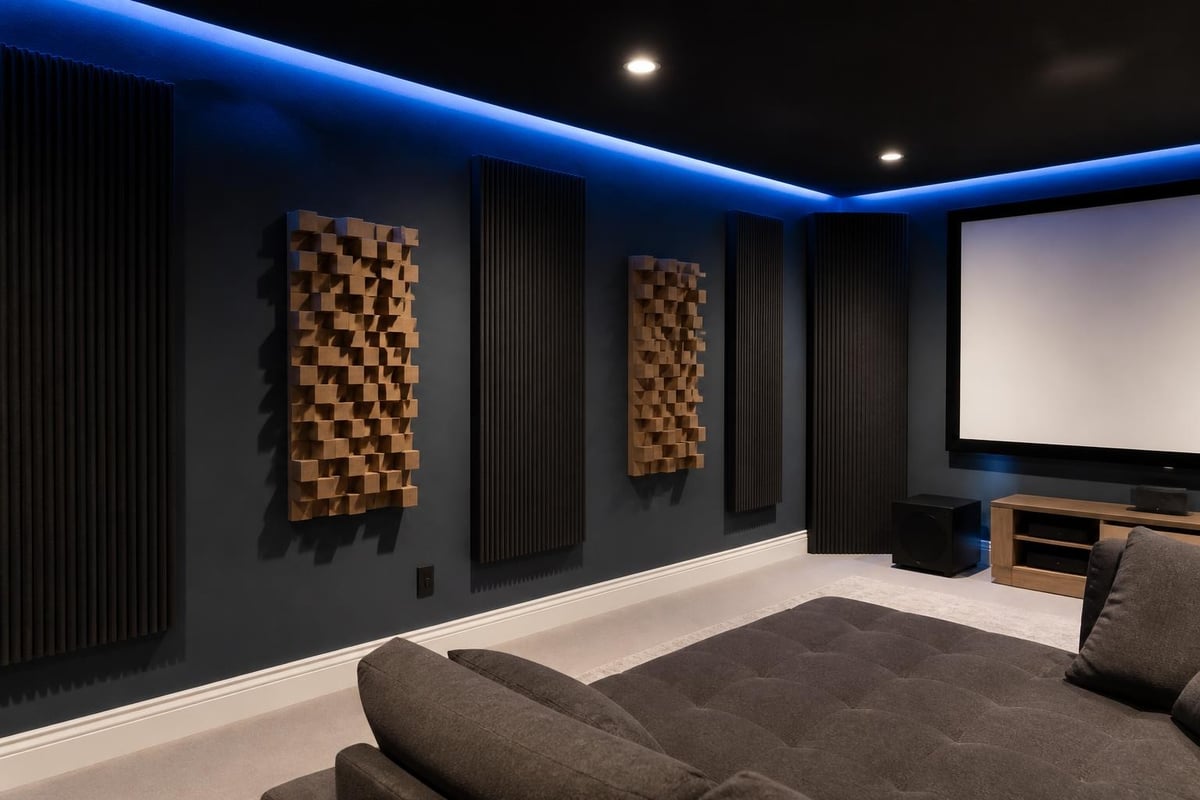
Room surfaces create reflections that either enhance or degrade surround sound performance. First reflections from side walls, the ceiling, and the floor arrive milliseconds after direct sound, potentially smearing imaging and reducing clarity.
Key acoustic treatment zones:
- First reflection points: Absorptive panels on side walls and ceiling
- Rear wall treatment: Diffusion to prevent flutter echo
- Bass traps: Corner placement for low-frequency control
- Ceiling clouds: Overhead absorption for height channel clarity
Dedicated home cinema installations benefit from comprehensive acoustic design that addresses reverberation time, modal resonances, and sound isolation. Recent research on spatial audio and room acoustics highlights how room characteristics interact with multichannel playback systems, influencing the perceived spatial quality.
Calibration and System Optimization
Raw speaker placement represents only the starting point for surround sound optimization. Calibration ensures all channels work together coherently, matching levels, timing, and frequency response to the listening environment.
Modern AV receivers include automated calibration systems that measure room acoustics and adjust system parameters accordingly. These systems use microphones placed at the listening position to analyze each speaker's output, measuring frequency response, distance, and level.
Audyssey MultEQ, Dirac Live, and similar room correction technologies apply digital signal processing to compensate for room-induced frequency response variations. The software measures the room's acoustic signature and generates filters that flatten peaks and smooth dips across the frequency spectrum.
Manual Fine-Tuning
Automated systems provide an excellent baseline, but manual adjustments often yield superior results for critical listening environments. Professional installers supplement automated calibration with measurement microphones and analysis software, verifying performance against established standards.
The ITU-R BS.1770-5 standard provides the reference methodology for program loudness and true-peak measurement, ensuring consistent playback levels across different source materials. This standardization becomes particularly important when switching between streaming services, Blu-ray discs, and broadcast content.
| Calibration Parameter | Target Range | Adjustment Method |
|---|---|---|
| Speaker level | ±0.5 dB (75 dB reference) | Receiver gain trim |
| Distance/delay | ±0.3 meters accuracy | Time alignment |
| Crossover frequency | 80 Hz (THX standard) | Subwoofer/speaker management |
| Frequency response | ±3 dB (20Hz-20kHz) | EQ/room correction |
Distance measurements ensure sound from all speakers arrives simultaneously at the listening position. A speaker three meters closer than another must have its signal delayed by approximately nine milliseconds to maintain proper time alignment.
Speaker Selection and Technology
The quality of individual speakers fundamentally determines surround sound system performance. While receiver specifications and room acoustics matter tremendously, speakers convert electrical signals into acoustic energy-the actual sound waves listeners experience.
Cinema-specific speakers prioritize different characteristics than general music speakers. High efficiency ratings enable dynamic peaks without distortion, robust power handling supports sustained high volumes during action sequences, and controlled directivity maintains consistent sound across multiple seating positions.
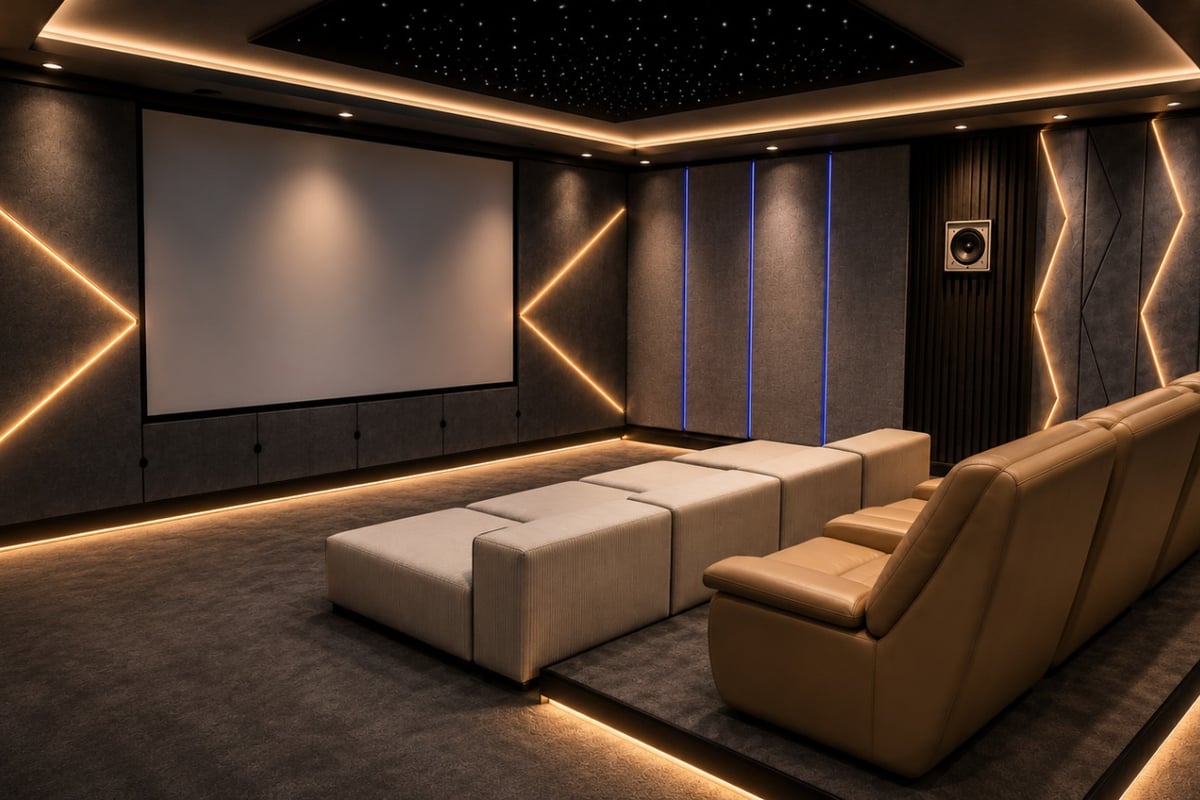
For custom home cinema installations, matching all speakers from a single manufacturer ensures timbral consistency as sound effects pan across channels. ANR media specializes in designing and installing home cinema rooms with carefully curated speaker selections that deliver cohesive surround sound performance, with comprehensive solutions ranging from R 350,000 to R 950,000 depending on room size and technology level.
Speaker Technology Considerations
Compression driver tweeters offer superior efficiency and dynamic capability compared to dome tweeters, making them ideal for front channels that reproduce dialogue and primary sound effects. Horn-loaded designs increase sensitivity while controlling dispersion, particularly valuable in larger rooms.
Subwoofer technology has advanced significantly, with dual voice coil designs, servo feedback systems, and digital signal processing enabling more accurate low-frequency reproduction. Multiple subwoofers distributed throughout the room smooth bass response variations caused by room modes, creating more consistent low-frequency performance across all seating positions.
Height channels for immersive formats require special consideration. In-ceiling speakers provide the most accurate overhead imaging but require construction access. Upward-firing modules that reflect sound off the ceiling offer a simpler alternative, though ceiling height and surface characteristics significantly influence their effectiveness.
Integration with Modern Source Devices
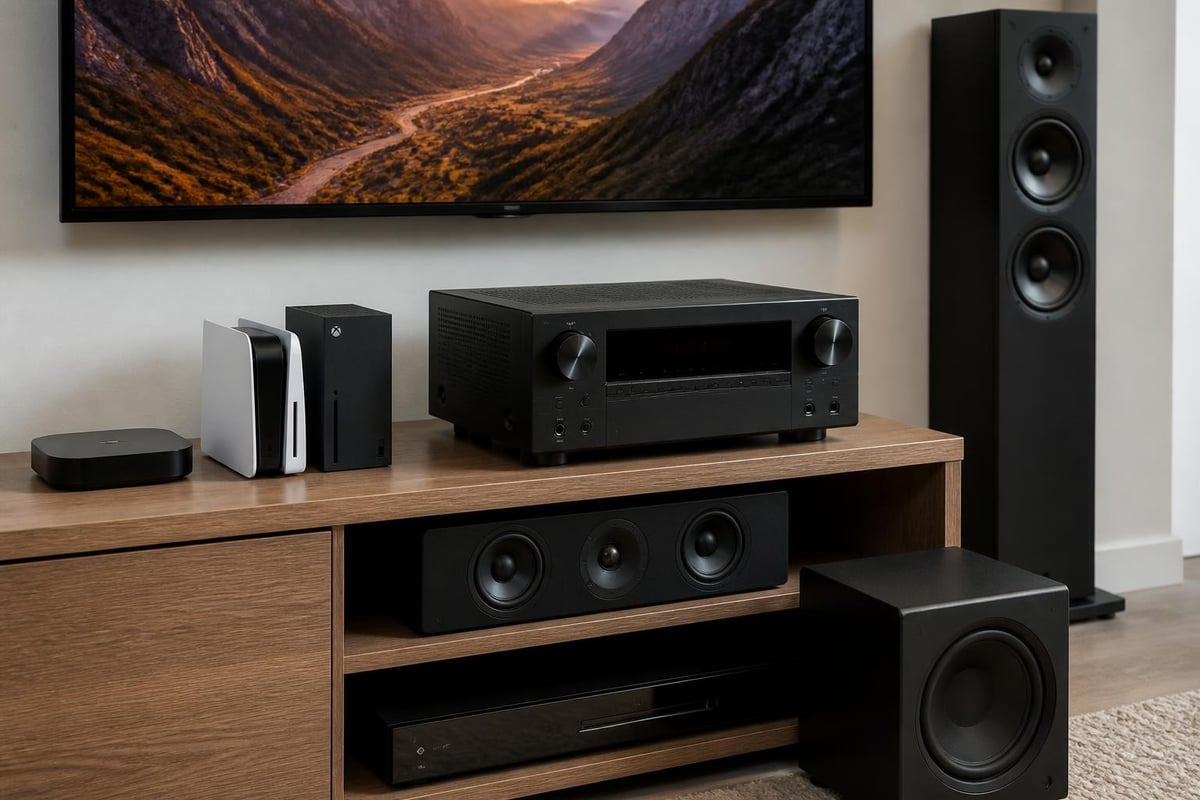
Surround sound systems in 2026 must accommodate diverse source devices and streaming platforms. The proliferation of 4K and 8K video content, combined with advanced audio formats, requires careful attention to HDMI specifications and signal routing.
HDMI 2.1 connections support enhanced audio return channel (eARC), enabling lossless Dolby Atmos and DTS:X pass-through from smart TV apps to the AV receiver. This capability proves essential as streaming services increasingly offer immersive audio tracks alongside standard surround sound options.
Source device compatibility checklist:
- HDMI 2.1 with eARC support
- Dolby Atmos and DTS:X decoding
- Streaming app Atmos compatibility
- Gaming console spatial audio features
- Network streaming bit-rate capacity
Gaming platforms now incorporate sophisticated spatial audio engines that work alongside surround sound systems. PlayStation 5's Tempest 3D AudioTech and Xbox Series X Dolby Atmos support demonstrate gaming's embrace of immersive audio, offering object-based sound design that rivals cinema productions.
Professional Installation Considerations
While entry-level surround sound systems suit DIY installation, sophisticated multi-channel configurations benefit from professional design and implementation. Expert installers bring acoustic knowledge, calibration tools, and integration experience that optimize system performance.
Professional installations address elements beyond speaker placement and wiring. Equipment rack organization, thermal management, remote control programming, and smart home integration create cohesive systems that deliver reliability alongside performance.
The AVIXA standards and guidelines establish professional practices for AV system design, installation, and verification. These standards ensure installations meet performance specifications and provide long-term reliability.
Custom Room Design Elements
Dedicated cinema rooms incorporate architectural elements that enhance surround sound performance from the initial design phase. Acoustic isolation prevents sound transmission to adjacent spaces while blocking external noise intrusion. Non-parallel walls reduce standing waves, and optimized room ratios minimize modal resonances.
Ceiling height influences overhead channel effectiveness for immersive formats. The CEDIA RP-22 practice recommends minimum ceiling heights of 2.4 meters for basic Atmos installations, with taller ceilings supporting more sophisticated configurations.
Seating geometry affects how many listeners experience optimal surround sound. The "sweet spot" in any multichannel system occupies a relatively small area where all speakers align correctly. Wider seating arrangements benefit from additional surround speakers and careful level balancing to expand the optimal listening zone.
Emerging Technologies and Future Developments
Surround sound technology continues evolving, with research institutions and manufacturers exploring new approaches to spatial audio reproduction. Wavefield synthesis, higher-order ambisonics, and binaural rendering represent alternative methodologies that may complement or extend traditional speaker-based systems.
The BBC Research & Development resources provide open datasets and tools for exploring binaural and three-dimensional audio rendering. These research initiatives investigate how to create convincing spatial audio experiences with fewer physical speakers or through headphones.
Artificial intelligence and machine learning increasingly influence audio processing. Adaptive systems analyze content in real-time, optimizing rendering decisions based on the specific audio mix and speaker configuration. Room correction algorithms leverage neural networks to model complex acoustic interactions more accurately than traditional parametric filters.
Wireless speaker technology promises to simplify surround sound installation by eliminating cable runs to rear and overhead speakers. Current implementations face latency and synchronization challenges, but ongoing development addresses these limitations. WiSA (Wireless Speaker and Audio Association) certified products demonstrate that wireless multichannel audio can achieve performance suitable for critical applications.
Understanding surround sound principles-from speaker placement and acoustic treatment to format selection and calibration-enables homeowners to create truly immersive entertainment environments that rival commercial cinema experiences. Whether you're planning a modest upgrade or a comprehensive dedicated theater, professional expertise ensures every element works together optimally. ANR media brings specialized knowledge in custom home cinema and audio-video installations, designing bespoke surround sound solutions from multi-room audio to complete cinema room conversions tailored to your space and performance goals.