

Cinema rooms represent the pinnacle of home entertainment, transforming ordinary spaces into immersive viewing environments that rival commercial theaters. As streaming services deliver increasingly sophisticated content and display technology continues to advance, homeowners are investing in dedicated cinema rooms that offer both technical excellence and luxurious comfort. These custom-designed spaces go far beyond simply mounting a large television on a wall, incorporating professional-grade audio systems, carefully calibrated video displays, acoustic treatments, and thoughtful design elements that create an authentic theatrical experience without leaving home.
Understanding the Cinema Room Advantage
A dedicated cinema room offers distinct benefits that multi-purpose living spaces simply cannot match. Complete environmental control allows you to manage lighting, sound, and seating arrangements specifically for optimal viewing conditions. Unlike a family room where compromises are necessary, cinema rooms are engineered from the ground up for one purpose: delivering the best possible audiovisual experience.
The acoustic isolation achieved in properly designed cinema rooms prevents sound from disturbing other areas of your home while simultaneously blocking external noise that would compromise immersion. This isolation works in both directions, meaning late-night movie sessions won't wake sleeping family members, and outside distractions won't interrupt pivotal scenes.
Technical Superiority
Cinema rooms enable the implementation of reference-quality audio systems that would be impractical in shared spaces. Dolby Atmos configurations with overhead speakers, multiple subwoofers for even bass response, and precisely positioned surround channels create three-dimensional soundscapes that transport viewers directly into the on-screen action. Dolby Atmos system design requires specific speaker placement and room geometry that dedicated cinema rooms accommodate perfectly.
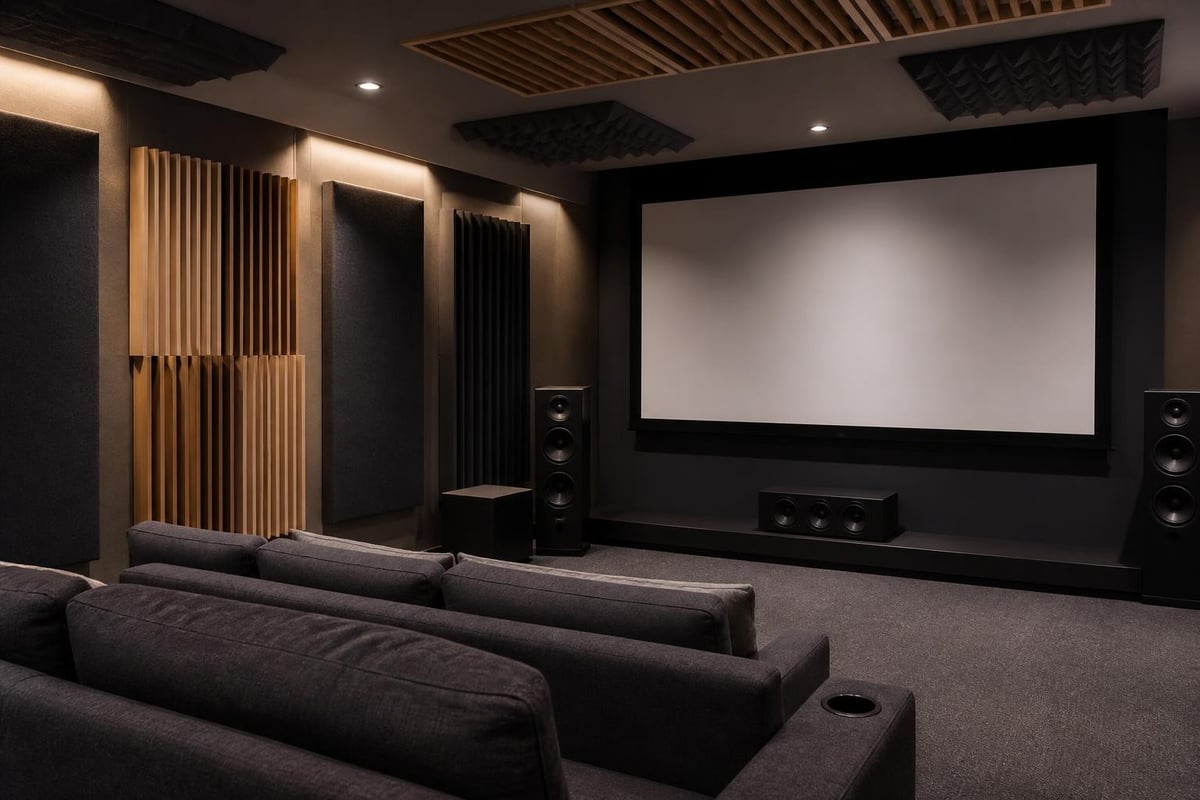
The video presentation in cinema rooms can be optimized without the visual compromises required in living spaces. Whether using a high-contrast projector with a motorized screen or a premium large-format display, the room geometry, seating distance, and ambient light control can be engineered to manufacturer specifications rather than adapted to existing furniture arrangements.
Planning Your Cinema Room Layout
Successful cinema rooms begin with thoughtful space planning that considers both technical requirements and human comfort. Room dimensions significantly impact acoustic performance, with certain ratios helping minimize standing waves and bass nodes that color sound quality. While perfect dimensions aren't always achievable in existing homes, awareness of these principles guides treatment strategies.
Seating arrangement deserves careful attention beyond simple comfort considerations:
- Viewing distance should place the screen within the optimal range for your display technology (typically 1.5 to 2.5 times screen width for 4K projection)
- Tiered seating ensures unobstructed sightlines for all viewers when multiple rows are necessary
- Aisle access allows entry and exit without disturbing other viewers
- Recline clearance provides adequate space behind each seat for full reclining function
| Room Dimension | Acoustic Impact | Mitigation Strategy |
|---|---|---|
| Length to width ratio | Standing wave patterns | Target 1.6:1 or Golden Ratio proportions |
| Ceiling height | Modal distribution | Vary ceiling height or use cloud absorbers |
| Parallel surfaces | Flutter echo | Angle walls or add diffusion treatments |
| Room volume | Reverberation time | Calculate treatment area for target RT60 |
Equipment location planning ensures clean installation while maintaining accessibility for service and upgrades. Projectors require specific throw distances, while equipment racks need ventilation and cable management infrastructure. Star wiring from a central equipment location to each speaker position, display, and control interface point simplifies troubleshooting and future modifications.
Audio System Design for Cinema Rooms
The audio system forms the emotional foundation of the cinema experience, with properly implemented surround sound creating the immersive environment that defines theatrical presentation. Cinema rooms allow for speaker placement that follows industry standards rather than compromising to fit existing decor.
Speaker Selection and Placement
Channel configuration determines the spatial resolution of your audio system. While traditional 5.1 surround provides basic directional effects, modern cinema rooms increasingly implement 7.1.4 or 9.1.6 configurations that add height channels for three-dimensional object-based audio. These systems place sounds precisely in the room space around listeners rather than just around the horizontal plane.
Timbre matching across all channels ensures seamless panning as sounds move through the soundfield. This requires using speakers from the same manufacturer series for front left, center, right, and surround positions. The center channel handles the majority of dialogue and should use a speaker with identical drivers to the left and right mains to maintain consistent tonal character.
Working with specialists who understand cinema-specific speaker design ensures your system delivers the dynamic range and low distortion necessary for modern soundtracks. Home cinema room installations benefit from expert guidance on matching speaker performance to room acoustics and viewing preferences, with custom solutions designed around your specific space and budget.
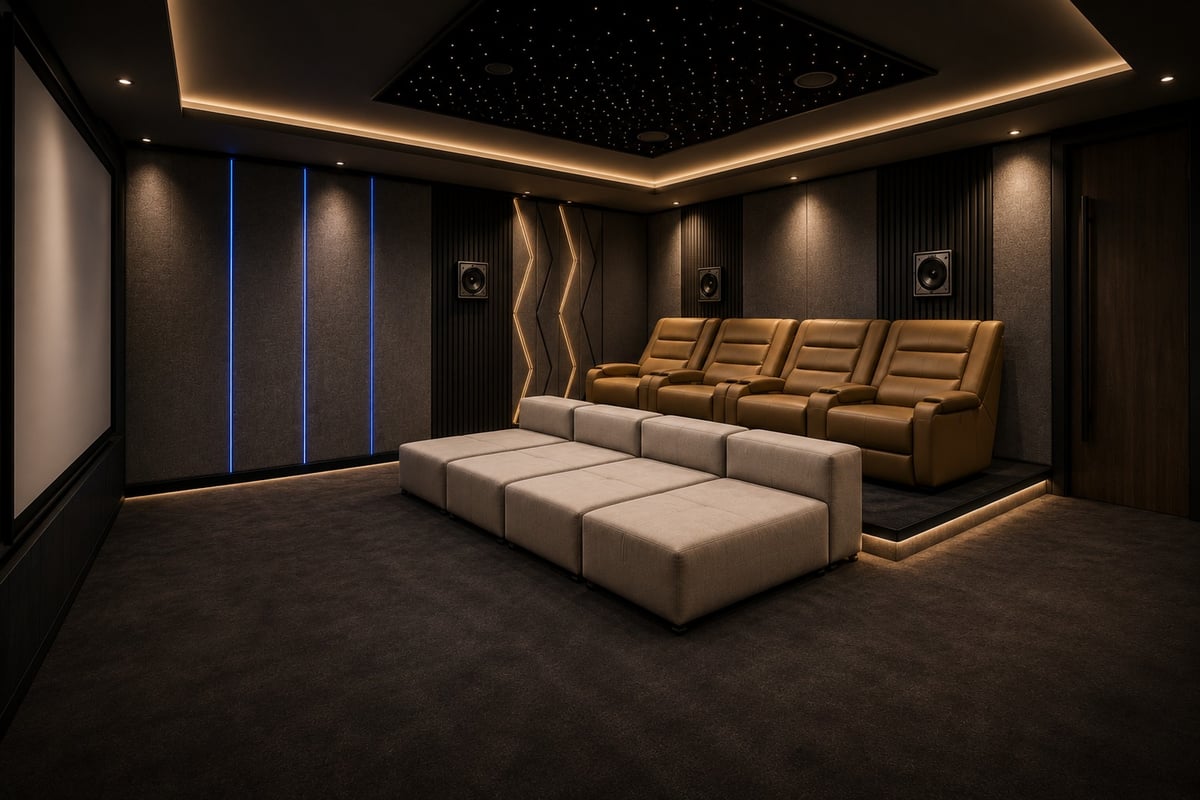
Bass management in cinema rooms requires special attention since low frequencies interact strongly with room boundaries. Multiple subwoofers positioned strategically throughout the space smooth the bass response, eliminating the peaks and nulls that single subwoofer placement creates. Calibration using measurement microphones and analysis software optimizes the crossover points, levels, and delays across all channels.
Video Display Optimization
The visual centerpiece of cinema rooms demands careful selection and calibration to deliver the image quality that modern content deserves. Projection versus direct-view displays represents the first major decision, with each approach offering distinct advantages for cinema applications.
Projection systems excel in cinema rooms designed for complete light control:
- Screen sizes from 100 to 200 inches create truly immersive experiences
- Fabric screens minimize visible pixel structure even at close viewing distances
- Lens memory systems store different aspect ratios for various content formats
- Laser light sources eliminate lamp replacement while expanding color gamut
Direct-view OLED and MicroLED displays bring their own strengths to smaller cinema rooms. Perfect black levels without any light bleed create infinite contrast ratios, while peak brightness capabilities now extend into the thousands of nits for HDR content. Screen size limitations remain the primary constraint, though 100-inch plus panels are becoming available at premium price points.
Calibration for Reference Performance
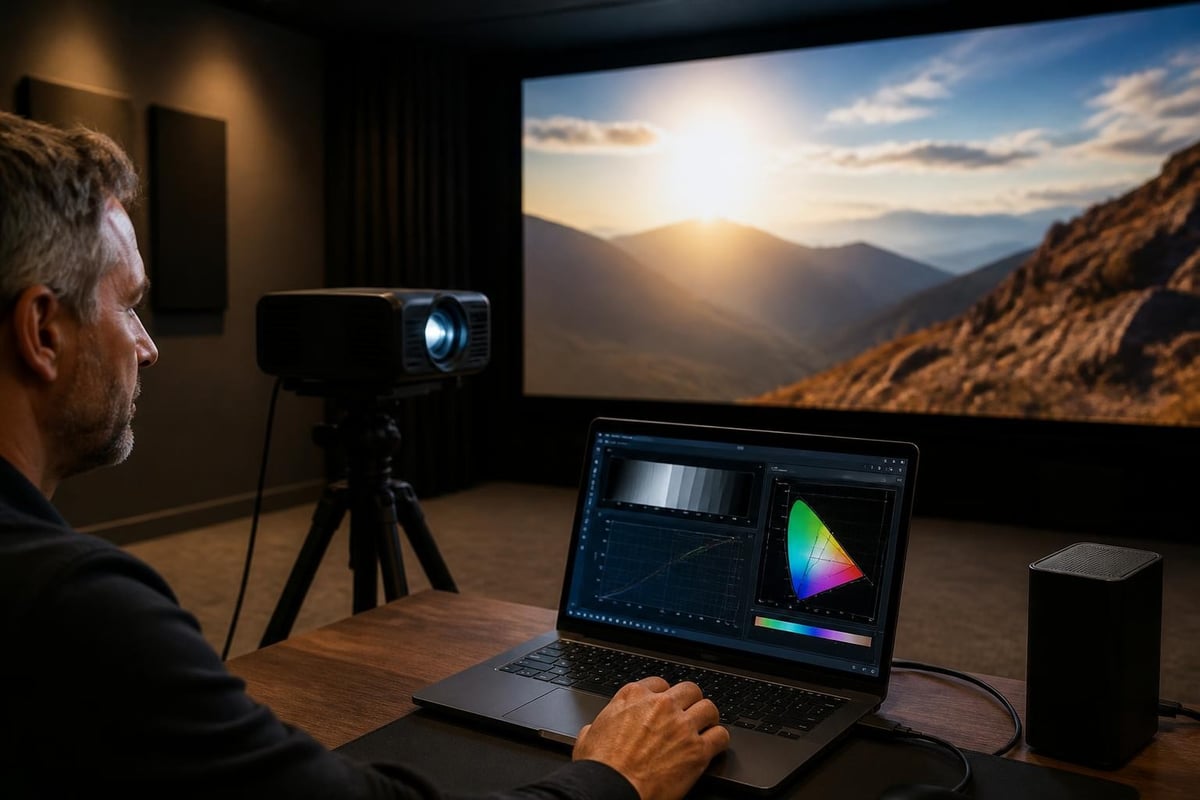
Professional calibration transforms capable displays into reference-quality monitors that reproduce content as directors and colorists intended. SMPTE standards define the color space, gamma curve, and white point targets that calibration aims to achieve, ensuring consistency across different displays and environments.
Cinema rooms benefit enormously from proper calibration because the controlled environment allows the display to perform at its peak capability. Without competing ambient light or reflections from bright walls, calibrated displays reveal subtle shadow detail and color gradations that would be invisible in brighter spaces. Professional calibration workflows measure and adjust hundreds of calibration points to ensure accuracy across the entire luminance range from pure black to peak white.
Acoustic Treatment Strategies
Raw room acoustics dramatically affect both audio clarity and spatial immersion, making acoustic treatment one of the most impactful investments in cinema rooms. Untreated rooms suffer from excessive reverberation, standing waves, and frequency response irregularities that blur dialogue, muddy bass, and collapse the soundstage.
Absorption materials control reflections that would otherwise arrive at listening positions milliseconds after direct sound from speakers. These delayed reflections reduce intelligibility and create a sense of acoustic distance that works against the intimate connection cinema audio aims to create. Strategic placement of absorption panels at first reflection points on side walls, ceiling, and rear wall addresses the most problematic reflections.
Bass frequencies require different treatment approaches due to their long wavelengths:
- Corner bass traps placed where walls meet absorb low-frequency energy that accumulates in room boundaries
- Membrane absorbers target specific problem frequencies where room modes create peaks
- Distributed subwoofer arrays reduce the magnitude of modal problems through careful placement
- Room dimension tuning during construction minimizes coinciding modes
Balancing Absorption and Diffusion
While absorption removes reflections, diffusion scatters them temporally and spatially to create a sense of space without the blurring effect of coherent reflections. Rear wall diffusion proves particularly effective in cinema rooms, breaking up reflections from the wall behind listeners that would otherwise create acoustic artifacts. The combination of absorption and diffusion creates an acoustic signature that feels neither overly dead nor excessively reverberant.
Cinema rooms designed by professionals incorporate these acoustic principles from the initial planning stages. CEDIA-certified integrators bring expertise in room acoustics, ensuring that treatment strategies complement rather than fight against room geometry and surface materials.
Lighting Design for Atmosphere and Function
Sophisticated lighting control separates exceptional cinema rooms from merely good ones. Multiple lighting zones on individual dimmers allow precise ambiance control throughout the viewing experience. Step lights along aisles provide safe movement during movies without screen washout, while adjustable overhead lighting accommodates pre-show socializing and post-screening cleanup.
Color temperature selection influences the perceived atmosphere significantly. Warm 2700K lighting creates an inviting, luxurious feeling appropriate for pre-show ambiance, while cooler color temperatures better suit task lighting for equipment areas. RGB color-changing systems offer complete flexibility, allowing mood lighting that complements movie genres or simply provides visual interest when the room sits unused.
Automated lighting scenes integrate with the overall control system to adjust lighting states based on activity. Starting a movie triggers a programmed sequence that dims the lights gradually, activates step lighting, and may even adjust controlled motorized shades. This automation enhances the theatrical experience while ensuring lighting doesn't require manual adjustment during viewing.
Integration and Control Systems
Modern cinema rooms incorporate numerous subsystems that must work together seamlessly. Unified control platforms consolidate operation of video sources, audio processing, lighting, climate, and shading into intuitive interfaces that family members and guests can navigate without technical knowledge or training.
Control interface options range from dedicated wall-mounted touchpanels to smartphone and tablet apps that provide the same functionality with the convenience of a device already in your pocket. Voice control through integrated assistants adds another interaction layer, allowing simple commands to trigger complex scenes involving multiple systems.
| Control Function | Implementation Approach | User Benefit |
|---|---|---|
| Source selection | Visual menu with artwork | Intuitive content browsing |
| Scene activation | One-touch buttons | Simplified operation |
| Volume adjustment | Distributed controls | Access from any seat |
| Environmental | Automatic optimization | Perfect conditions without manual adjustment |
System reliability becomes paramount in cinema rooms where multiple family members expect consistent operation. Professional integration ensures proper configuration, network infrastructure, and support arrangements that keep systems functioning reliably rather than becoming frustrating obstacles to entertainment.
Construction and Materials Considerations
Building or converting a space into a dedicated cinema room involves construction decisions that impact both performance and aesthetics. Wall construction techniques determine how effectively the room isolates sound from adjacent spaces. Double-stud walls with staggered studs, resilient channels, and multiple layers of mass-loaded vinyl and drywall create the isolation necessary for late-night viewing without disturbing other household members.
Flooring materials influence both acoustics and comfort. Carpet over padding provides acoustic absorption for floor reflections while offering luxurious comfort underfoot. Raised flooring systems in larger cinema rooms accommodate tiered seating while concealing power and data cabling that runs to each seating row.
Ceiling treatments range from simple painted acoustic panels to elaborate coffered designs that incorporate absorption and diffusion while adding visual interest. Fabric-wrapped panels integrate seamlessly into upscale designs while providing critical acoustic function. The ceiling also houses overhead speakers for Atmos systems, requiring thoughtful integration that maintains both acoustic performance and aesthetic appeal.
Climate Control Integration
Dedicated HVAC systems for cinema rooms address the unique requirements these spaces present. Equipment generates significant heat that must be removed without creating noise that compromises the audio experience. Ultra-quiet air handlers and carefully designed ductwork with internal lining minimize system noise while maintaining comfortable temperatures.
Humidity control protects sensitive electronic equipment while maintaining comfort. Excessively dry air creates static electricity issues and can damage certain speaker components, while high humidity risks condensation on cold surfaces and mold growth within HVAC systems. Maintaining relative humidity between 40 and 60 percent optimizes both equipment longevity and viewer comfort.
Seating Selection for Comfort and Function
Cinema room seating represents a significant investment that directly impacts the enjoyment of every viewing session. Motorized recliners with infinite position adjustment, integrated heating and cooling, and massage functions transform extended viewing sessions from endurance tests into luxurious experiences. Material selection balances durability, maintenance requirements, and aesthetic preferences, with leather and premium synthetics offering easy cleaning and long service life.
Seating geometry affects both comfort and room acoustics. High-backed seats provide head and neck support while creating acoustic barriers that reduce sound transmission between rows. Seat width and spacing determine capacity while influencing comfort, with wider spacing improving egress and personal space at the cost of total occupancy.
Accessory integration enhances functionality beyond basic seating. Built-in tray tables provide convenient surfaces for refreshments without requiring separate furniture. USB charging ports, tablet holders, and reading lights add functionality for those occasions when the cinema room serves multiple entertainment purposes. Storage compartments under seats or in armrests keep remotes, blankets, and personal items accessible yet organized.
Cinema rooms deliver unparalleled home entertainment experiences through the careful integration of premium audiovisual systems, acoustic optimization, and thoughtful design that creates truly immersive viewing environments. Whether you're planning a dedicated theater in new construction or converting an existing space, working with experienced professionals ensures your investment delivers the performance and reliability you expect. ANR media specializes in custom home cinema solutions, from complete room conversions to multiroom audio video systems, delivering bespoke installations tailored to your space, preferences, and budget.