

A 5.1 home cinema system remains the gold standard for immersive home entertainment in 2026. This configuration delivers cinematic sound quality that transforms your living space into a private theater, combining five discrete speakers with a dedicated subwoofer to reproduce soundtracks exactly as directors intended. Whether you're watching the latest blockbuster or streaming your favorite series, understanding how to properly configure and optimize a 5.1 home cinema setup will dramatically enhance your viewing experience.
Understanding the 5.1 Configuration
The numerical designation "5.1" tells you everything about the system's architecture. The "5" represents five full-range speakers positioned strategically around your listening area, while the ".1" indicates a single subwoofer dedicated to low-frequency effects.
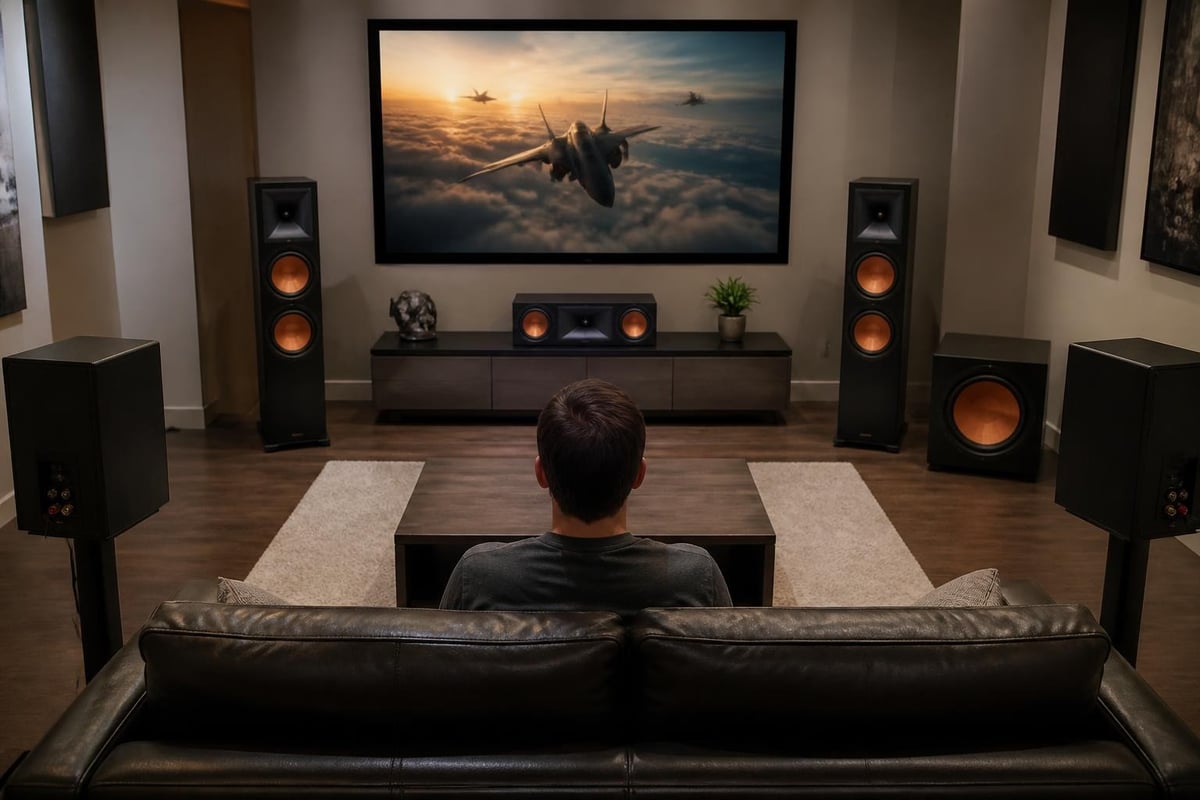
This speaker arrangement includes three front-stage speakers and two surround speakers. The front soundstage consists of a center channel speaker, positioned directly below or above your display, plus left and right front speakers flanking your screen. The two surround speakers sit to your sides or slightly behind your primary seating position.
Why Five Speakers Matter
Each speaker in a 5.1 home cinema plays a distinct role in creating the complete soundscape. The center channel handles roughly 60% of a film's dialogue and on-screen action, making it arguably the most critical component. Your front left and right speakers reproduce music, ambient sounds, and off-screen effects, creating width and depth to the sonic presentation.
The surround speakers add dimensionality by placing sounds behind and beside you. When a helicopter flies overhead in a movie, these speakers create the sensation of movement through your space. The subwoofer reinforces explosions, musical bass, and low-frequency effects that smaller speakers cannot reproduce.
Speaker Placement Fundamentals
Proper speaker placement separates mediocre 5.1 home cinema installations from exceptional ones. Precise speaker positioning according to industry standards ensures you hear soundtracks as audio engineers mixed them.
Front Speaker Positioning:
- Position your center channel directly above or below your screen at ear height when seated
- Place front left and right speakers at 22 to 30 degrees from your central viewing position
- Match the tweeter height of all three front speakers for seamless sound panning
- Angle (toe-in) front speakers slightly toward the listening position
Surround Speaker Guidelines:
- Mount surround speakers 90 to 110 degrees from the center position
- Position surrounds 1 to 2 feet above ear level when seated
- Maintain equal distance from surrounds to the primary listening spot
- Use bipole or dipole speakers for more diffuse surround effects
The subwoofer placement offers more flexibility since bass frequencies are largely non-directional. However, corner placement typically maximizes output, while positioning the subwoofer along the front wall between your main speakers often provides the most balanced response. Detailed surround sound placement guides can help you fine-tune your specific room configuration.
| Speaker Type | Placement Angle | Height Position | Distance Consideration |
|---|---|---|---|
| Center Channel | 0° (directly ahead) | Ear level | Match to screen position |
| Front L/R | 22-30° from center | Ear level | Equal distance from listener |
| Surround L/R | 90-110° from center | 1-2 ft above ear level | Equal distance from listener |
| Subwoofer | Flexible | Floor level | Corner or front wall optimal |
Selecting Your 5.1 Components
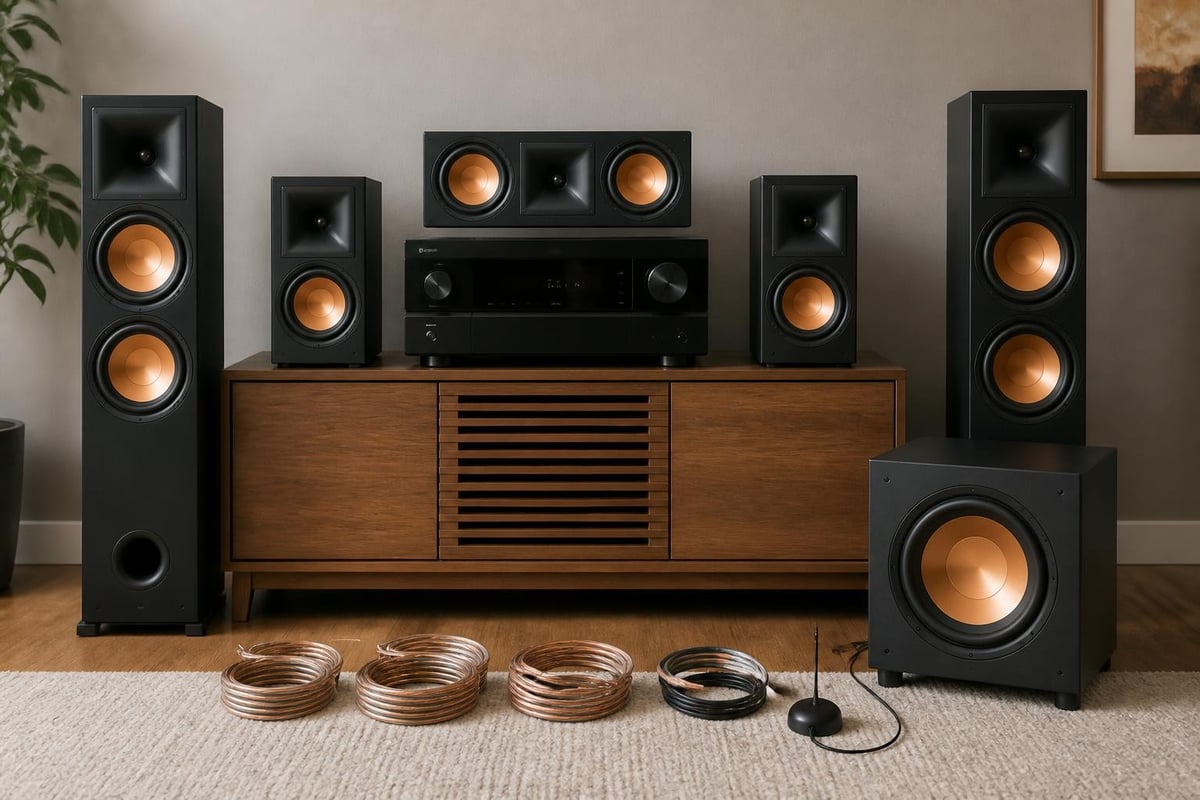
Building an effective 5.1 home cinema requires matching components that work harmoniously together. Your system's performance depends on selecting equipment appropriate for your room size, budget, and acoustic environment.
AV Receiver Selection
The AV receiver serves as your system's brain, processing audio signals and powering your speakers. Modern receivers in 2026 support advanced audio formats including Dolby TrueHD and DTS-HD Master Audio, delivering lossless surround sound from Blu-ray discs and streaming services.
Look for receivers with adequate power output for your speaker sensitivity ratings. A receiver rated at 80 to 100 watts per channel suits most residential installations. Ensure the receiver includes automatic room correction technology like Audyssey, Dirac, or YPAO, which compensates for acoustic irregularities in your space.
Speaker Matching Principles
Purchasing matched speakers from a single manufacturer ensures timbral consistency across channels. When sounds pan from your front speakers to surrounds, mismatched speakers create audible discontinuities that break immersion.
Consider these factors when selecting 5.1 home cinema speakers:
- Sensitivity rating: Higher sensitivity (90dB or above) requires less amplifier power
- Impedance: Most home speakers use 8-ohm impedance, though 4 or 6 ohms are common
- Frequency response: Look for front speakers reaching down to 40-50Hz to minimize subwoofer burden
- Build quality: MDF cabinets with robust bracing reduce unwanted resonances
For those seeking premium performance, specialized cinema speakers designed specifically for home theater applications deliver exceptional dialogue clarity and dynamic range. M&K Audio manufactures speakers engineered exclusively for cinema reproduction, prioritizing the characteristics that matter most for film soundtracks rather than music playback.
Room Acoustics and Treatment
Even the finest 5.1 home cinema equipment underperforms in acoustically problematic rooms. Sound waves reflect off hard surfaces, creating echoes, standing waves, and frequency response irregularities that muddy dialogue and reduce impact.
Acoustic Challenges
Bare walls, hardwood floors, and large windows create excessive reflections. Bass frequencies build up in corners and at specific room dimensions, causing boomy, uneven low-frequency response. Parallel walls generate flutter echoes that color the sound.
Strategic acoustic treatments include:
- Absorptive panels at first reflection points on side walls
- Bass traps in room corners to control low-frequency buildup
- Diffusion on the rear wall to scatter surround speaker reflections
- Area rugs or carpeting to reduce floor reflections
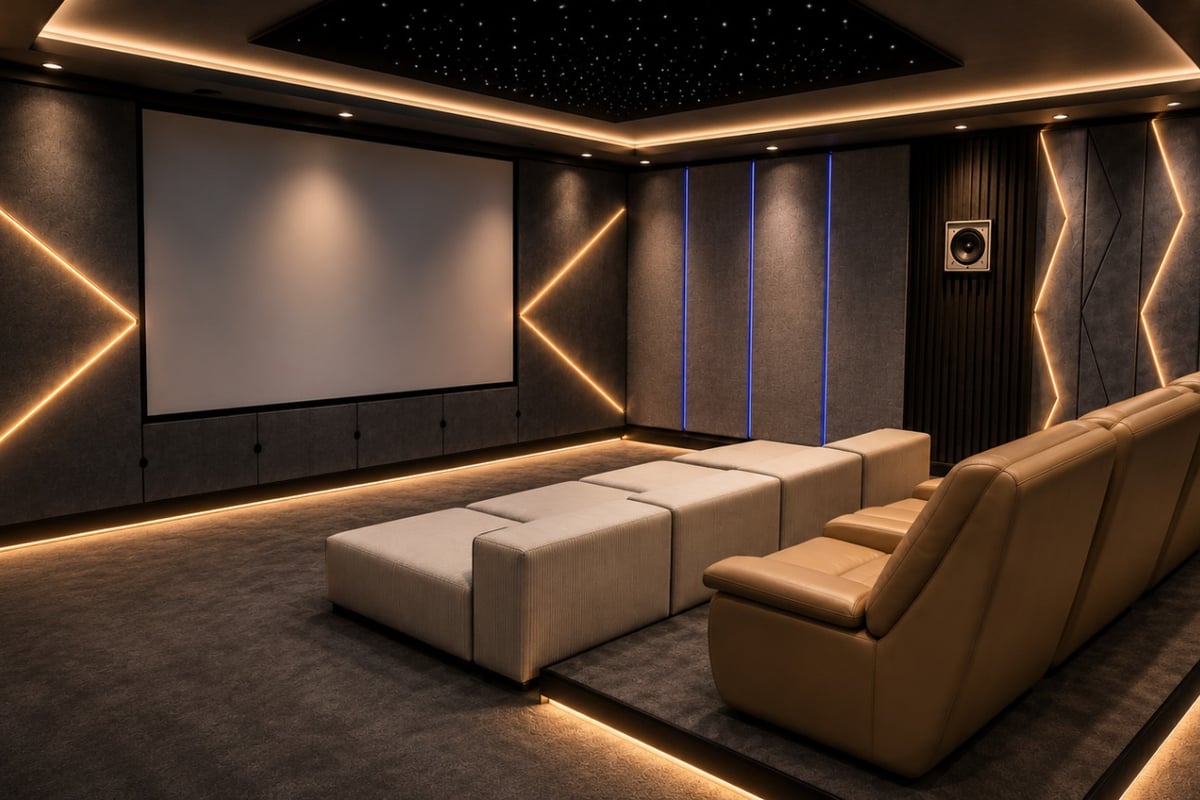
Professional installation of a home cinema room addresses these acoustic challenges during the design phase, incorporating treatments into the architecture rather than adding them as afterthoughts. This integrated approach delivers superior results while maintaining aesthetic appeal.
Room Size Considerations
Your room dimensions influence both equipment selection and placement options. Smaller rooms (under 200 square feet) benefit from compact bookshelf speakers that don't overwhelm the space. Larger rooms demand floor-standing towers with greater output capability.
The ideal listening distance for a 5.1 home cinema falls between 1.5 and 2.5 times your screen's diagonal measurement. This ensures you sit close enough for immersive surround effects without being so near that you notice individual speakers rather than a cohesive soundfield.
Calibration and Optimization
Proper calibration transforms a collection of speakers into a cohesive 5.1 home cinema system. Modern AV receivers include automatic calibration routines that measure your room's acoustic properties and adjust settings accordingly.
Automatic Calibration Process
- Connect the included calibration microphone to your receiver
- Position the microphone at your primary listening position at ear height
- Run the automated measurement sequence while the room remains silent
- Review and fine-tune the automatic settings for personal preference
- Perform additional measurements at multiple seating positions for optimization
The calibration system sets individual speaker levels, distances, crossover frequencies, and equalization curves. This process compensates for speaker placement variations, room acoustics, and equipment differences.
Manual Refinement
After automatic calibration, manual adjustments often improve results. Use a sound pressure level (SPL) meter or smartphone app to verify all speakers play at 75dB when fed test tones. Adjust the subwoofer crossover to blend seamlessly with your main speakers, typically between 60Hz and 120Hz depending on your speaker's bass extension.
Fine-tuning checklist:
- Verify speaker distances match physical measurements
- Check phase alignment between subwoofer and mains
- Adjust surround level 1-2dB above fronts for enhanced effects
- Set dynamic range compression for late-night viewing
- Configure lip-sync delay if video lags audio
Different surround sound configurations offer varying levels of immersion, but the 5.1 home cinema format provides the best balance of performance and practicality for most installations.
Content Sources and Formats
Your 5.1 home cinema reaches its full potential only when fed high-quality source material. The format and quality of your content directly impacts the sonic experience.
Physical Media
Blu-ray discs deliver uncompressed or lossless surround sound through Dolby TrueHD and DTS-HD Master Audio codecs. These formats preserve the complete audio information from the studio master, providing reference-quality sound reproduction. Ultra HD Blu-ray adds Dolby Atmos and DTS:X object-based audio, though these formats require additional height speakers beyond basic 5.1 configurations.
Streaming Services
Major streaming platforms now offer 5.1 surround sound on premium content. Netflix, Disney+, Amazon Prime Video, and Apple TV+ provide Dolby Digital Plus 5.1 on compatible titles. While streaming audio uses lossy compression that reduces file sizes, modern codecs deliver impressive quality that satisfies most listeners.
| Source Type | Audio Format | Quality Level | Bandwidth Required |
|---|---|---|---|
| Ultra HD Blu-ray | Dolby TrueHD / DTS-HD MA | Lossless | N/A (physical) |
| Standard Blu-ray | Dolby TrueHD / DTS-HD MA | Lossless | N/A (physical) |
| Netflix 4K | Dolby Digital Plus | Lossy | 25 Mbps |
| Cable/Satellite | Dolby Digital | Lossy | Variable |
| Gaming Consoles | Dolby/DTS | Varies | N/A |
Gaming Applications
Video game consoles including PlayStation 5 and Xbox Series X output native 5.1 home cinema audio. Modern games feature sophisticated audio engines that position sounds with pinpoint accuracy, enhancing gameplay immersion. Competitive gamers gain tactical advantages from directional audio cues that reveal opponent positions.
Common Setup Mistakes to Avoid
Even experienced enthusiasts make errors when configuring 5.1 home cinema systems. Recognizing and avoiding these pitfalls ensures optimal performance from your investment.
Placement Errors:
- Positioning surround speakers directly behind the seating rather than to the sides
- Mounting speakers too high or too low relative to ear level
- Placing the center channel inside an entertainment cabinet, muffling dialogue
- Failing to maintain symmetry in speaker distances
Configuration Problems:
- Setting incorrect speaker size (large vs. small) in receiver settings
- Using mismatched speaker cable lengths or gauges
- Neglecting to verify phase/polarity across all speakers
- Skipping the calibration process entirely
Acoustic Oversights:
- Ignoring first reflection points on walls and ceiling
- Placing speakers against walls without considering boundary reinforcement
- Operating in rooms with excessive echo or reverberation
- Positioning seating directly against the rear wall
Some users consider soundbar alternatives for simplified installation, but discrete 5.1 home cinema speaker systems deliver substantially better performance and upgradeability compared to all-in-one solutions.
Upgrading from Stereo to Surround
Transitioning from two-channel stereo to 5.1 home cinema represents a significant leap in audio quality and immersion. The upgrade path can happen incrementally rather than requiring immediate purchase of all components.
Begin by acquiring a capable AV receiver and center channel speaker. This 3.0 configuration already improves dialogue clarity over stereo setups. Add the surround speakers next to experience directional effects and ambient sounds. Complete the system with a subwoofer to reproduce low-frequency effects.
Alternatively, some listeners prefer starting with a 3.1 setup (front three speakers plus subwoofer) before adding surrounds. This approach prioritizes the critical front soundstage and bass foundation before expanding to full surround capability.
Budget Considerations
Quality 5.1 home cinema systems in 2026 span a wide price spectrum. Entry-level packages start around $500 for compact speaker systems paired with basic receivers. Mid-tier installations ranging from $2,000 to $5,000 deliver substantially better performance with premium components. High-end custom systems exceed $10,000, incorporating reference-grade speakers and processing.
Allocate your budget proportionally across components. As a general guideline, dedicate 40% to speakers, 30% to the AV receiver, 20% to the subwoofer, and 10% to cables and accessories. This distribution ensures balanced performance without bottlenecks.
Maintenance and Longevity
Properly maintained 5.1 home cinema equipment delivers decades of reliable service. Unlike computer technology that becomes obsolete within years, quality audio components remain relevant far longer.
Routine maintenance tasks:
- Dust speakers and receiver ventilation grilles monthly
- Verify speaker wire connections remain secure annually
- Update receiver firmware when manufacturers release improvements
- Re-calibrate after moving speakers or changing room furnishings
- Inspect speaker surrounds for deterioration in humid climates
Store remote controls in consistent locations and replace batteries before they leak. Keep owner's manuals and calibration settings documented for reference. Consider photographing your cable connections before disconnecting equipment for moves or upgrades.
Speaker technology evolves slowly compared to video displays. A well-chosen 5.1 home cinema speaker system purchased in 2026 will likely perform admirably in 2036, even as video technology advances through multiple generations. This longevity makes speakers one of the best value propositions in home theater equipment.
A properly configured 5.1 home cinema system transforms how you experience entertainment, delivering the director's intended soundscape in your own space. Understanding speaker placement principles, selecting matched components, and optimizing your room acoustics ensures you extract maximum performance from your investment. Whether you're building your first surround system or upgrading from stereo, the immersive experience of discrete multi-channel audio represents a meaningful improvement over basic television sound. ANR media specializes in custom home cinema installations, from selecting the ideal components for your space to professional calibration that maximizes your system's potential, ensuring every element works together to create truly cinematic sound.